

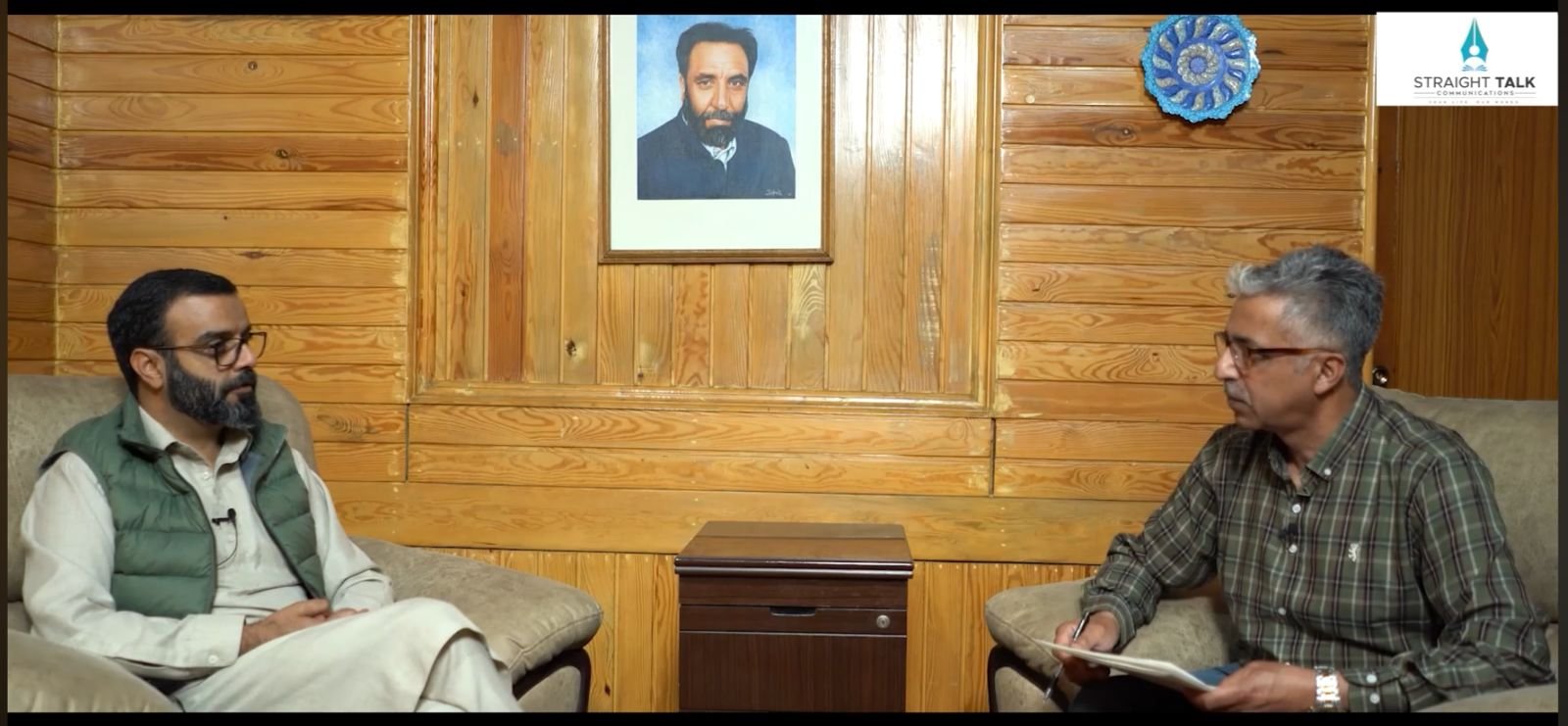
A Straight Talk session with National Conference Member of Parliament from the Srinagar constituency, Aga Syed Ruhullah Mehdi, conducted some time back is reproduced here to the delight of the readers. He talked about various issues, taking a dig at the Omar-led government as well as the Centre government for what he called failing to meet the aspirations of the people of Jammu and Kashmir. He has been very vocalincriticising his own party – the National Conference (NC) – leadership. Aga Syed Ruhullah Mehdi is a personality, who in a very short span of time, has carved out a significant political space for himself and achieved a tall standing among the general public. He is trying his best to be people’s voice as he has been consistent in raising their issues at various levels. His consistent criticism against his own party (National Conference) hints at scripting of a revolt within the party and can be described in one word – mutiny.
Here are the excerpts of the session hosted by Sajjad Bazaz, Editor at Times Link.
Sajjad Bazaz: How do you view the political, economic, and social scenario of your region – Jammu and Kashmir?
Ruhullah Mehdi: Health of economy depends heavily on the political situation. So, it’s the political health of the region that derives social health, economic health, and the way institutions function. Since the political situation of J&K is poor, its effects on other sectors are visible accordingly. Precisely, the impact of poor political health flows down into every sector, and the health condition of our economy is no exception to the given scenario. If you look at the past several years, unemployment is at an unprecedented high. This was not the case earlier. Money circulation has drastically reduced. Earlier, people earned through horticulture, agriculture, and other sectors, and money circulated in the economy. Today, capital circulation is minimal, and people are suffering losses.
The reason is our political situation. Our status was downgraded, our powers were taken away and our authority to make decisions was snatched. Because of this, uncertainty still prevails. Command and control are being run from the Centre in a manner that fulfils the political agenda of a particular party, the BJP. The suffering of the local population does not seem to matter to the powers at the Centre.
Sajjad Bazaz:Who is responsible for this mess that you identified?
Ruhullah Mehdi: The decisions taken in 2019 are responsible for all the mess. Earlier, even if situations worsened economically or socially, the state had powers, an empowered assembly and an empowered government to fix things. But in 2019, all those powers were taken away. The assembly was downgraded, the government was downgraded.The BJP and its ideology—originating from the RSS—are responsible for the situation prevailing here today.Now, speaking of the last 30–40 years:
Yes, there was violence and bloodshed earlier. But for nearly 40 years after accession, there was no such violence. The bloodshed that later occurred was due to an ideology we opposed. We supported neither gun – neither this one nor that one. We fought those circumstances. The people of the state fought. We made sacrifices.
If you observe carefully, the situation in the 1990s was far worse than in the 2000s, and it continued to improve afterward. I invite you to research the parameters – health, education, employment, social equality etc.. Before 2019, despite challenges, Jammu and Kashmir ranked among the top 10 states of India on most of the parameters. Those facts cannot be wished away. Precisely, what happened in 2019 turned empowered citizens into second-class citizens. That was a drastic change for an entire state.
Sajjad Bazaz:Is Kashmir a dispute or an issue?
Ruhullah Mehdi: Vocabulary differs, but the basic reality is this: It is an issue that needs to be addressed.Decisions about Kashmir have never been taken according to the will of its people, especially the decisions of 2019. Even the 1987 elections, which many experts cite as the root cause of turmoil, should be judicially examined. Fix responsibility. Reach a final settlement.
Ordinary youth paid the price, not politicians. If someone didn’t become an MLA, does that justify sending others’ children to graves?
If mistakes were made, fix accountability. Set up a judicial commission. The BJP has ruled here for nearly 10 years now by way of law and order, home department, all under their control. So why keep repeating the same narrative?
I was not responsible for 1987. I was nowhere there. I did not contest elections, rig elections, or participate in wrongdoing. I cannot be a prisoner of someone else’s mistake. I have my own conscience.
The people of Jammu and Kashmir have been gradually disempowered year after year. We must fight against this disempowerment.
As a sitting MP, I do not accept the current status quo. I consider it undemocratic and unconstitutional, imposed against the wishes of the people.
Sajjad Bazaz: But violence after 2019 has drastically declined…
Ruhullah Mehdi: Do numbers matter more than lives? People have been killed even after 2019 – including security forces, civilians, locals and outsiders. Militancy incidents have spread beyond the Valley into Jammu as well. Violence graphs go up and down, but this cannot be approached mathematically.
The cause remains unresolved. Anger, alienation, and resentment still exist. They may be suppressed, but they are not addressed.
This silence is not peace, it is forced silence.
Thousands of youth are still detained. Journalists are not allowed to report freely. Raids continue. Passports are seized. Journalists and activists are jailed under UAPA, often without trials, and many of them are lodged in jails outside their home region. In such an environment, how can one claim that silence equals peace?
Sajjad Bazaz:How do you visualise your political career and internal criticism?
Ruhullah Mehdi: I do not want to give myself marks or feel complacent. This is a journey of service. Only when I stop, I will look back and judge my work.
I do not consider myself a celebrity. People trust me because I have remained consistent—what I said before elections, I said after elections, in Srinagar and in Delhi alike.
When I spoke in Parliament about Article 370, I was not alone because I wanted to be – I was alone because others were silent.
My statements are not internal party matters; they concern public policy. These issues belong to the people. Transparency is their right.
I never spoke about internal party functioning, only about public policies. If asked, I speak honestly.There have been no party meetings—no working committee meetings—so the question of ignoring me does not arise. I represent my conscience and the people, not silence.
Sajjad Bazaz:How do you view the abrogation of Article 370?
Ruhullah Mehdi: I genuinely believe that the rights taken away should be restored. The language may differ, the nomenclature may change—but dignity, rights, and constitutional guarantees must return.
Article 370 is part of the Indian Constitution, not an external document. Our struggle is for dignity, rights, and the guarantees promised at accession. I cannot dictate for 15 million people. Whatever arrangement the people accept, I will respect.
Sajjad Bazaz:What is your take on restoration of the Statehood?
Ruhullah Mehdi: Everything has been made hostage to statehood. Promises were made in the manifesto, but now everything is deferred.Statehood alone is not the final objective, it is part of what was taken away in 2019. The real struggle is to reclaim all lost (what was before 2019).
I do not see the BJP returning statehood voluntarily. They disempowered us to gain votes elsewhere – why would they empower us again?
Rights are not given; they are fought for and taken back.
Sajjad Bazaz:How would you like to describe the Kashmiri youth?
Ruhullah Mehdi: Youth have suffered across generations. Their future remains uncertain. The core solution is empowerment. Without authority, without dignity, no scheme can help.
Today, Kashmiri youth fight for identity before competing academically. And it has become a norm that they have to first prove they are not terrorists, not anti-national. This constant humiliation is suffocating. Give them equal opportunities, dignity, and a level playing field. Let them be masters of their own destiny. Unfortunately, leadership is missing. A vacuum still exists.
Sajjad Bazaz:What is your message to them?
Ruhullah Mehdi: Do not lose hope. Trust in God. Remain peaceful and united. Fight with wisdom, for dignity, rights, and self-respect. This election itself was a form of peaceful pushback.
Sajjad Bazaz:You were chargesheeted in a land grab case. Would you like to comment on the charges levelled against you?
Ruhullah Mehdi: I have no active involvement. The land in question was inherited from my grandfather. Negotiations were handled by my uncle. I only received ₹80,000 as compensation. There was no influence, no signatures, no pressure, no wrongdoing.
BOX ITEM
MP Ruhullah’s Key Areas of Criticism
- Ruhullah has accused his own party leadership of “betrayal of public mandate” and failing to deliver on key promises made to the people of Jammu and Kashmir, especially regarding the restoration of statehood and constitutional guarantees like Article 370.
- He feels a lack of accountability in the governance system – both the government and the National Conference, arguing that the performance of the Omar-led government reflects “lack of accountability, and only scripted stories of betrayal”.
- He often has been criticizing the NC’s approach as a “surrender” of core values for political power, blaming the party for showing more concern with positions of power than the people’s struggles.
- He has been using the issue of reservation policy as a major whip to lash at the Omar-led government for failing to remove its imbalance. His protest against the government’s reservation policy caught the NC government in a surprise. He has been arguing that the policy is flawed, inflicting disparity on a segment of the citizenry.
- Ruhullah’s open criticism against his own party leadership and skipping to campaign for the party’s candidate for Budgam Assembly constituency is precisely a ‘revolt’. Besides, his walk out during a National Conference Working Committee meeting after a heated ideological clash with Omar Abdullah is enough evidence that all is not well inside the National Conference. The situation simply speaks of severe internal discord. If reports and political analysts are to be believed, a possibility looms large that a new political front may emerge if NC leadership ignores the criticism of its MP Ruhullah.
- Commenting about his loyalty to the party, Ruhullah says that his loyalty is to his conscience and the people who elected him, not to political ranks or party ego. He states that his criticism is basically a demand that his party returns to a principled political path.