

Serving people requires humility, even if that means knocking on doors or holding someone’s feet for the sake of justice, says Syed Mohammad Altaf Bukhari
Governance in Jammu and Kashmir has emerged as a hot issue after the elected government took over reigns of power vested with them under the Union Territory structure. The Lieutenant Governor has the supreme power when it comes to the governance of the region. To be precise, the governance here is loaded with a double engine where the elected government remains powerless without the power of a second engine – popularly known as the LG driven administration.
In other words, the power structure to drive the governance in a union territory structure is always like the one we observe here in Jammu and Kashmir. A popular belief is strengthening where it’s ‘believed’ that statehood alone can empower an elected government to have total control over the governance and implement its agendas.
Even as the elected government has been pursuing with the centre to restore statehood to the region, the centre seems in no mood to listen to the pleas as for them, as dished out through statements from time to time, the time is not ripe even to think of granting statehood. Gauging the mood of the centre, the chief minister Omar Abdullah of late dished out his ‘doubt’ that centre may grant statehood to Jammu and Kashmir. For him, no chances are in sight.
However, one of the seasoned politicians, who rose to the popularity as frontline political leader in a quick time, Syed Mohammad Altaf Bukhari, President Apni Party, doesn’t look conservative when he stated that he would have got statehood for Jammu and Kashmir, had the people voted him in power in the last assembly elections held in November 2024. Interestingly, he lost the elections. He directly blames people for remaining in UT status.
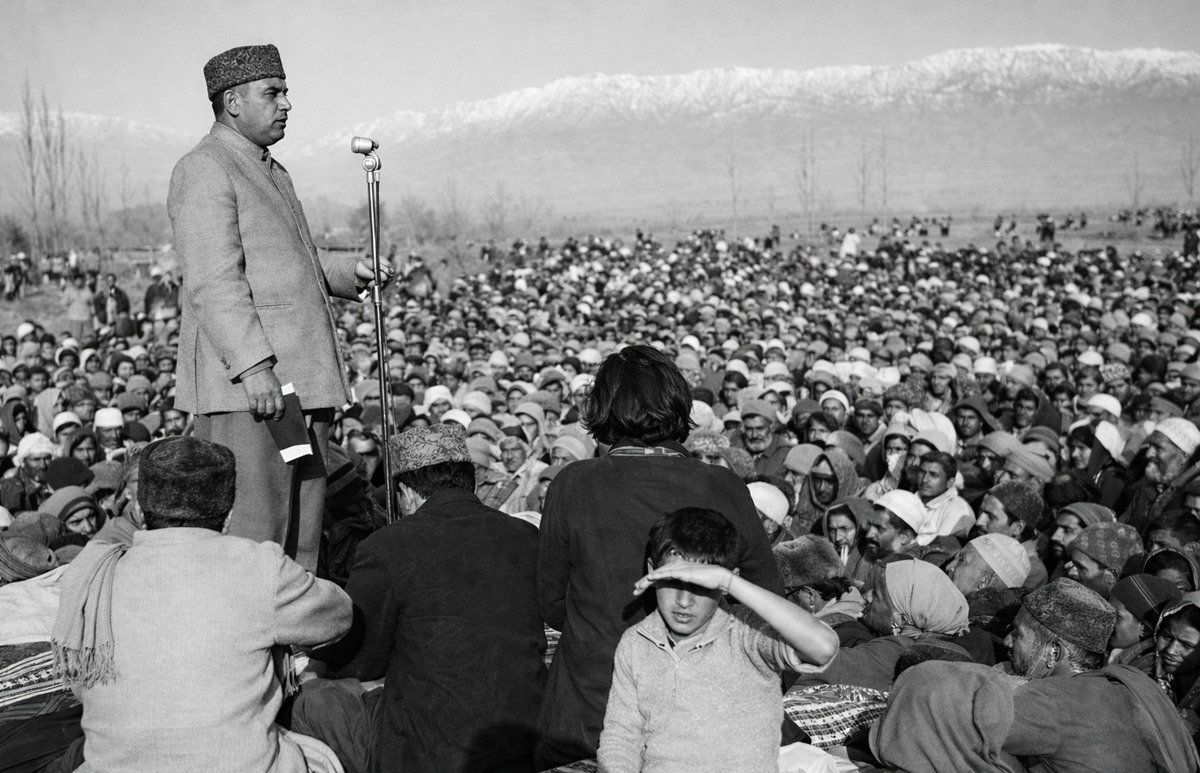
A confident Syed Mohammad Altaf Bukhari during a STRAIGHT TALK session with Sajjad Bazaz made a point-blank remark about the governance strategy needed at this point of time which, according to him, will bring peace and prosperity to the people of the region and at the same time fully integrate Jammu and Kashmir with the union of India. “Kashmir needs another Bakshi – Ghulam Mohammad Bakshi,” he said while taking a dig at the present system of governance in Jammu & Kashmir.
TIMES LINK: Even though you are not currently in the Assembly, maintaining political relevance itself is a big achievement. You come from a reputed business family and were a well-known businessman. What led to your transition from a comfortable business life into politics?
ALTAF BUKHARI: That is a very relevant question. Every person has hobbies or interests outside their profession. Just as businessmen often play golf or pursue leisure activities to relax, my interest was different. Whenever I had free time, I would sit with friends who were already in politics. I observed closely how they addressed people’s problems and served society. Somewhere along the way, a feeling developed within me that serving people is the greatest form of worship.
Our family shared a close relationship with the late Mufti Mohammad Sayeed. At that time, I was not convinced that hereditary politics was a good thing. Across India and South Asia, political families dominate, but I believed democracy would be stronger if individuals rose on merit rather than lineage.
Mufti Sahib once insisted that I contest elections actively. I resisted for three to four months, but he continued persuading me, saying Srinagar needed a credible face with capability. I argued that people knew me only as a businessman, but eventually, one fine day, I agreed.
In 2014, I contested from the Lal Chowk constituency. People supported me, and by God’s grace, I won. I firmly believe that I never betrayed the trust of those who voted for me.
TIMES LINK: During the 2014 floods, your relief work was widely appreciated. You were seen personally visiting affected areas. Had you already decided by then to enter politics?
ALTAF BUKHARI: My exposure to politics began much earlier. I still remember 1984, when G.M. Shah removed Dr. Farooq Abdullah through a no-confidence motion. I was very young, but that was my first real brush with politics.
At that time, despite Dr. Farooq Abdullah having a strong mandate, power politics in Delhi played a decisive role. The government that followed, though short-lived, delivered remarkable development and employment with almost no corruption. Politics back then was value-driven.
However, I never took an active role later, mainly because my father was not keen on my involvement. It was not until the PDP was formed that my association deepened again, largely because of my closeness to Mufti Mohammad Syed Sahib.
After he was replaced by Ghulam Nabi Azad in 2005, I remained consistently by his side until his death. Over time, I became PDP treasurer, and in 2009, I was nominated for the Rajya Sabha, though I lost the election.
TIMES LINK: In 2014, you contested elections independently without senior PDP leaders campaigning for you.
ALTAF BUKHARI: Yes. I went door to door as Altaf Bukhari, not as a party symbol. I told people clearly: “If you vote for me, you will not be ashamed.” I believe that honesty resonated with voters.
TIMES LINK: The PDP’s alliance with the BJP became a turning point. Did you oppose it?
ALTAF BUKHARI: Yes, I was the first MLA Mufti Sahib called. I clearly said we should sit in the opposition. We had taken votes to keep the BJP out. I opposed the alliance openly, even in harsh words, and Mufti Sahib listened patiently.
Ultimately, the party leadership decided otherwise. I stayed away from party meetings for a month and openly expressed my disagreement to the media. Later, Mehbooba Ji intervened and convinced me.
TIMES LINK: Tell us about your ministerial experience
ALTAF BUKHARI: I was appointed Works Minister and later handled Education, Finance, Labour, and Floriculture. After the 2014 floods, rebuilding infrastructure was a massive challenge. We worked day and night, and even Government of India review teams acknowledged the transformation.
Education, however, turned out to be the most impactful portfolio of my life. I truly believe education is next only to religion in importance. During my tenure, not a single FIR was filed against students, and no student was arrested. I told students they had the right to protest peacefully within campuses, not on the streets.
TIMES LINK: How do you view the unrest that erupted in 2016 when you were in power and later you were excluded from the government?
ALTAF BUKHARI: After Mufti Sahib’s death, Mehbooba Ji took time to form the government. I was initially excluded and later inducted as Education Minister during a very turbulent period marked by unrest after Burhan Wani’s killing.
I thank God that my hands were not stained with blood during that period. I was not part of the cabinet decisions when over 200 people were killed. Perhaps God kept me away deliberately.
TIMES LINK: Why did government collapse in 2018?
ALTAF BUKHARI: When the BJP withdrew support, Mehbooba Ji had the option of seeking a floor test but did not. Several leaders left the party, but I stayed. Later, when PDP leaders met to discuss revival, I openly told Mehbooba Ji that leadership failures had cost lives in 2016 and trust thereafter.
On January 19, 2019, I was EXPELLED from the PDP. When asked for my reaction, I said: “Alhamdulillah, I am free.”
TIMES LINK: What is your stand on abrogation of Article 370 and demoting the region from a State to Union Territory on August 5, 2019? It is said Altaf Bukhari knew this beforehand.
ALTAF BUKHARI: I had absolutely no prior knowledge of the abrogation of Article 370. It was as much a shock for me as for every Kashmiri. We were repeatedly told this could never happen.
What hurt the most was the silence of mainstream political parties after August 5, 2019. People needed leadership the most during that period, but parties remained inactive, even though they could issue expulsion orders.
We began engaging with authorities to secure the release of detained leaders and restore basic functioning viz transport, markets, and communication.
TIMES LINK: What led to the formation of a new political front – J&K APNI PARTY in 2020?
ALTAF BUKHARI: We realised that engagement with Delhi was necessary. The pain inflicted on Jammu and Kashmir came from Delhi, and the remedy also lay there. We pushed for domicile protections, land rights, and job security for locals.
On March 8, 2020, we formed a new political party – APNI PARTY. On April 1, domicile laws were amended to protect land and jobs for residents of Jammu and Kashmir. Unfortunately, COVID-19 lockdowns prevented us from communicating these achievements effectively.
TIMES LINK: Where do traditional political parties stand?
ALTAF BUKHARI: Traditional parties have lost public trust through repeated betrayals. They thrive on emotional blackmail and false promises. Article 370 cannot be restored through courts; only Parliament can do it. Similarly, statehood will not return unless leaders engage honestly and collectively with the central government.
TIMES LINK: Many youth are languishing in jails. Hardly anybody talks about them. Do you have any strategy to initiate a process to get them out of jails?
ALTAF BUKHARI: Yes, hundreds of Kashmiri youth are jailed across India on mere suspicion. If perpetrators of Pahalgam or any other attacks have been identified and eliminated, why are innocent youth still imprisoned? Leadership must rise above the politics of numbers and acknowledge human suffering.
TIMES LINK: Whoever has assumed the seat of power in Jammu & Kashmir, governance has always been called ‘inefficient’. What according to you should be done to make governance vibrant and earn the peoples’ trust?
ALTAF BUKHARI: Kashmir might need another leader like Bakshi Ghulam Mohammad for his perceived ability to deliver development, stability (during his time), and a pragmatic, almost paternalistic, integration with India through patronage and state-led progress (like infrastructure). However, there were negatives of his rule, which need to be dumped, not repeated. My viewpoint for a Bakshi-like figure in present times is for development & infrastructure. Bakshi’s era saw significant development, construction of roads, bridges, and tourist spots, bringing tangible benefits to the region. Stability and integration has been a hallmark of his rule. He provided a long period of political stability and fostered stronger ties with India by strategically integrating the state politically and economically. Even pragmatic leadership is worth quoting and emulating. He was seen as a shrewd politician who understood Kashmiri sentiment, balancing hard measures with populist measures and patronage to manage public psychology.
However, let me clear it, when I say Bakshi-like figure, I mean his strong pro-people measures delivering peace, progress and prosperity should only be emulated. Obviously, the problematic side of his governance is what should not be looked at if public trust is to be maintained.
TIMES LINK: What is your message to the people of J&K?
ALTAF BUKHARI: I appeal to people to reject hereditary and traditional politics. Bring forward new leadership untainted by past failures. True freedom will begin the day people stop treating politics as inherited property.
Serving people requires humility, even if that means knocking on doors or holding someone’s feet for the sake of justice.
I confidently say we would have got the statehood by now, had people voted us to power in the last Assembly elections.