

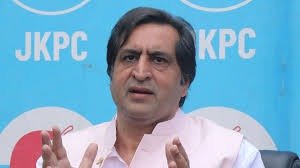
“End all debates and decide things purely on a scientific basis. And apply remedy on a scientific basis.”
Jammu and Kashmir People’s Conference MLA Sajjad Lone has been very vocal against the reservation policy. The current reservation policy is being used as a tool to exclude Kashmiri-speaking population from power structure and reorder the social supremacy in the Union Territory (UT), he said.
“Attempts are being made to change the social supremacy by disempowerment. It looks like reordering through the current reservation policy. After 20 years, very few Kashmiri-speaking people will be seen in the Secretariat of J&K,” the JKPC Chief said.
Referring to the Kashmiri-speaking population, comprising Muslims and Hindus, as a “distinct ethnic group”, Lone highlighted the figures that show lower representation of the Kashmiri-speaking population in competitive examinations like J&K Administrative Services (JKAS) in recent years.
“Each passing day, Kashmiri-speaking candidates figure less in the results of competitive examinations. This is not because they are incompetent but because the space was being squeezed. They are being crowded out from the competitive space by virtue of system of reservation, which is totally rigged against them by the current 60% reservation policy,” he says.
Presenting a statistical data, Sajad Lone says that figures suggest that the Kashmiri-speaking population who qualified for the JKAS examination was 19% in 2023, 25% in 2022 and 21% in 2021. “An internal survey needs to be carried out to check the net loss to Kashmiri-speaking population if this reservation policy did not exist in J&K,” hesuggested.
Lone urges the Omar Abdullah-led government to rationalise the current reservation policy. “Kashmir region has no SC population. In the Kashmir region, ST population is 40% and in the Jammu region, it is 60%. ST living in the Jammu region are comparatively marginalised and scattered unlike Kashmir region where entire constituencies belong to the ST communities. ST communities should be allowed to compete more within the Jammu region,” Sajad Lone said.
He said Kashmir being a conflict State should ideally see special measures but “reverse is happening”. “For 30 years, discourse from Delhi was ‘teach them a lesson’ and ‘show them their place’. This is a post-dated cheque for disaster. The last 30 years Kashmir region has seen turmoil and violence. Overall mental makeup has gone through a lot. That script was written by enemies and this script is written by us,” Lone said.
Taking a dig at bureaucrats who drafted the reservation policy, Sajad Lone says they will leave J&K “but we will face a social disorder”. “If you are going to push merit to the wall and not give them admission in colleges, it will cause disorder that our children will have to face. It is something generational,” he said.
He called for a “scientific and statistical analysis of reservations”. Explaining the method of analysis he intends to undertake, Lone said, “We need data on actual merit in an examination held for recruitment. We need data on the last ten recruitment examinations. Which means that we produce actual marks scored by the candidates and prepare a merit list without applying reservations. Next, we get the actual selection list. The difference between a merit list without applying reservations and a merit list after applying reservations gives us the exact damage inflicted upon the Kashmiri-speaking ethnic group.”
According to PC President, the selection data from ten examinations would serve as a sample, which can later be expanded to derive a statistically significant figure in assessing the extent of what he called “damage.”
“If the government does actually come up with anything, we will apply that new reservation system to the last ten recruitment lists released by the government and see whether it changes anything or makes matters worse for the Kashmiri-speaking ethnic group,” he said.
Describing the approach as evidence-based and rational, Lone said, “Now this is a scientific procedure. Let us end all debates and decide things purely on a scientific basis. And apply remedy on a scientific basis.”