


Sajjad Bazaz
If you belong to our generation, you’d have definitely indulged in one activity which was very popular not only in our neighbourhood but throughout the country. Yes, I am talking about kite flying. It was a passion to fly tiny colourful quadrangular in the sky and I still remember all the joys kite flying used to bring to us, when we were kids.
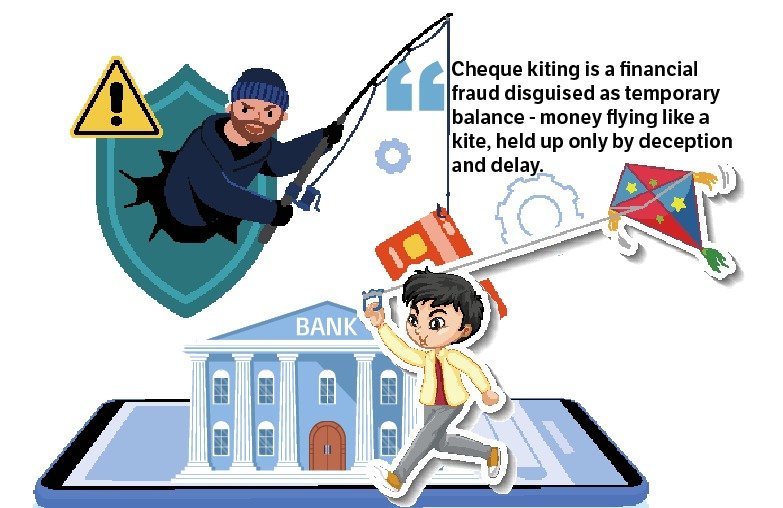
Generally speaking, kite flying brings joy to the kite flyers as well as to the people who watch them. But, kite flying has a different connotation when discussed in the context of banking and finance. Kite flyers are disliked in the banking system and their kiting is considered one of the most dangerous activities in the world of finance. Precisely, in the context of banking and finance, kite flying means swindling funds from the financial institutions through a series of manipulations.
Also known as kiting, the Investopedia explains it as ‘the fraudulent use of a financial instrument such as a cheque to obtain additional credit that is not authorised. It has two variants. One, the act of misrepresenting the value ofa financial instrument for the purpose of extending credit obligations or increasing financial leverage. Second, a fraudulent act involving the alteration or issuance of a cheque or draft with insufficient funds.
I am privy to many such cases where kiting was common when banks were not automated. The physical mode of clearing of cheques between banks used to take a lot of time. It used to be an uphill task to keep track of the movement of financial instruments for realisation of their value. It’s here fraudsters used to take advantage of this delay. They used to write cheques of bank accounts actually having no funds to realise the amount. These cheques were used by them at some other bank where they used to manage that their cheques as “Bills Purchased” instruments. Through some influence in the banks they used to get realisation of their cheques delayed as per their will and get the amount deposited before the cheques were cashed.
However, integration of the advanced technology into the banking operations has considerably reduced time for cheques to clear and that has helped to reduce the incidence ofcheque kiting. In short, the act of kite flying is an unfair and illegal means of obtaining bank funds by drawing fictitious bills ofexchange which have actually no exchange of consideration among the parties. Who can forget the fraud done in Punjab National Bank some years back through kite flying technique. Here the Letter of Undertaking (LoU) was used to swindle funds. This LoU is an explicit undertaking used to raise overseas loans. It is a facility through which a bank offers it’s undertaking to another bank on behalf of its customer, who is importing goods from overseas. The customers raise loans from the overseas banks through the LoU. It’s a clear-cut responsibility of the issuing bank. The maturity of a Letter of Undertaking could be between 30 days and one year, depending on the type ofbusiness. The idea behind having such a scheme is to enable an importer to access low-cost foreign currency funds overseas.
Notably, the genesis of PNB fraud that surfaced by using LoU mode was that Nirav Modi, main accused in PNB Scam, ‘devised’ a scheme to take route of bank loans ‘without actually taking a loan. This means using banks’ money without opening a loan account. He managed LoU from PNB to raise overseas loans at cheap rates. Surprisingly, he didn’t pay any margin while arranging an LoU from PNB (otherwise banks ask for a margin for LoU and it could be even more than 100 per cent of the credit facility required). The overseas loans raised through these LoUs were also not repaid within the stipulated period of time. So, in this perfect example ofkite flying, instead of paying his own money, Nirav Modi asked PNB to open another LoU, which could cover the principal plus interest ofthe previous LoU. Backed by new LoUs, he would get fresh and higher buyer’s credit, which would enable him to clear the previous loans and the chain continued.
Meanwhile, kite flying continues in the banking system in another form as the kite flyers too have capitalised on the power of technology to continue kiting. In fact, it has broad-based its presence into digital banking products and has now been extended to credit cards as well.
So, we have kite flyers of another kind now. However, this form ofkite flying, precisely card kiting, is not a fraud. But, its growing arena is not at all comfortable for the banks. A cardholder resorting to card kiting indicates that he/she is in a tight financial position and is not able to foot the credit card dues.
What exactly is kite flying in banking parlance?
Let’s first look at the historical perspective of the practice of kite flying, also known as kiting, in banking system. According to the Wikipedia, the practice of kite flying in the banking system started in 1920s when the term “cheque kiting” first came into use. “It stemmed from a 19th century practice of issuing I Owe You (IOU) instruments and bonds without any collateral. That practice became known as ” flying a kite,” as there was nothing to support the loan besides air.
An IOU (abbreviated from the phrase “I owe you) is usually an informal document acknowledging debt. It differs from a promissory note as an IOU is not a negotiable instrument and does not specify repayment terms such as the time ofrepayment. IOUs usually specify the debtor, the amount owed, and sometimes the creditor. IOUs may be signed or carry distinguishing marks or designs to ensure authenticity. In some cases, IOUs may be redeemable for a specific product or service rather than a quantity of currency, constituting a form of scrip.
As described in pre-paras, the practice of kite flying in the banking system is an intentional attempt to write a cheque for a value greater than the account balance from an account in one bank, then writing a cheque from another account in another bank, also with non-sufficient funds, with the second cheque serving to cover the non-existent funds from the first account.
In other words, kite flying is basically a technical term used for a type offraud through financial instruments such as cheque, involving the illegal use offinancial instruments to fraudulently obtain a sort of loan without actually applying for a loan. It is the illegal practice of drawing cheque on account for a value greater than the account balance in one account and then depositing another cheque in that account having insufficient balance by falsely inflating the balance in the account so that the cheque gets cleared. So, while relying on the float time required for a cheque deposited at one bank to clear at another, the practitioners of kite flying typically write a cheque at the first bank against an account at the other. Before that cheque clears, they then withdraw the funds from the second bank account and deposit the funds back into the first. The process may then be repeated in the opposite order, sometimes repeatedly. The net result is a series of fraudulent withdrawals that rely on being a step ahead ofthe fraudulent cheque on which they are based having cleared.
For instance, a person has multiple bank accounts in his name. He wrote himself a cheque for Rs.10,000 from his account in Bank A and deposited it in another account in Bank B on Monday. However, the balance in Bank A is only Rs.1,000. So, he promptly (before clearance ofthe previous cheque) withdrew Rs.10,000 from Bank B and deposited it in Bank A on Tuesday, which means that now Bank A has sufficient funds to honour the cheque written on Monday. The virtual fund perpetually cycles this way until the financial crunch is resolved and the person clears the debt, usually unnoticed by the bank. There is every possibility of the scam getting exposed. This is a classic example of cheque kiting in which the person uses bank’s funds fraudulently.
(This is the extract of the author’s forthcoming book – STRAIGHT TALK: DECODING CONTEMPORARY BANKING)