


Arun Joshi
The mountains are majestic, but they are forbidding, too. This is not a metaphor or some poetic expression, but a real-time challenge that pilgrims face when they trek high passes and brave the vagaries of the weather to reach the holy cave shrine devoted to Lord Shiva in the Himalayas in Kashmir. The journey to the cave is a real-time test of breath, bone and belief.
Pilgrims’ immense faith in their Lord overpowers all difficulties as they feel spiritual bliss and a sense of satisfaction in having lived up to their faith year after year. This is a story only they can tell, perhaps because their inner feelings can never be fully translated into the human vocabulary of any language. This is what spiritualism is all about.
Against a breath taking backdrop of gushing glacial rivers , mesmerizing peaks and the valleys as though the heaven itself touched the earth to make the journey blissful? This has been happening for over a century now, but something is changing with every passing year.
For well over a century, this sacred rhythm has endured, anchored by an unshakeable faith that conquers every natural obstacle. Yet, even as the eternal devotion remains untouched, something subtle and profound is shifting in the mountains with every passing year.
Deep within Hindu scripture lies the tale of Lord Shiva revealing the secret of immortality to his divine spouse. For centuries, the sacred cave where this narration took place remained hidden, until Kashmir’s history was forever altered by a Muslim shepherd named Buta Malik.
What makes Malik’s story truly remarkable is his immediate intuition: he knew exactly who would cherish this profound discovery. Recognizing its spiritual value, he brought news directly to the Kashmiri Pandits, whose deep devotion to the Shivlingam he had long witnessed .
Since then, the pilgrimage has embodied Kashmir’s traditional ethos, which has initiated and sustained this journey of faith to this day.
This opens a new perspective centered on three elements:
• Hindu mythology
• Kashmir’s ethos of mutual coexistence and respect
• The physical journey itself
Every part of the trek inspires a spiritual awakening, echoing the teachings in Hindu scriptures. These texts repeatedly instruct us to worship mountains, trees, rivers, and all of nature’s blessings with utmost faith. Ultimately, this translates to protecting the environment and respecting the natural order instead of tampering with it.
There is an unquenchable thirst to have the “darshan” of the deities at the earliest so that pilgrims can manage their time according to their convenience. This is part of religious pilgrimages everywhere, and the Amarnath Yatra is no exception.
The Changing Shape of the
Pilgrimage
Until the 1970s, the pilgrimage used to be a simple but profound journey motivated by faith and spiritualism .Most pilgrims—a majority of whom came from Kashmir itself, with a small number from other parts of the country—would follow a particular tradition: moving along the Charri Mubarak (the holy mace of Lord Shiva), which started from Dashnami Akhara in Srinagar.
The journey had several stopovers from Srinagar to the cave shrine: Bijbehara, Anantnag, Mattan, Pahalgam, Chandanwari, Sheshnag, Panchtarni, and then the cave shrine itself. All arrangements were managed by the government. Today, affairs are still managed by the government, but under the overarching supervision of the Shrine Board .
The Shri Amarnath Shrine Board was set up following the 1996 tragedy, in which more than 240 pilgrims and porters were waylaid by untimely snowfall, avalanches, and floods. However, the Nitish Sengupta panel’s recommendation to restrict the number of pilgrims to 100,000 has been largely ignored. Another recommendation—stating that no more than 5,000 pilgrims be allowed on each of the two routes—has also not been followed. The number of people wishing to undertake the journey increases every year. At the same time, large campaigns actively attract more pilgrims, as the religious journey has taken on broader national significance.
In recent years, the annual yatra has undergone many changes, which can easily be attributed to the eruption of armed militancy in Kashmir. Until the start of the militancy in the Valley in 1990—the watershed year of this phenomenon—the yatra was an organic Kashmiri affair. It had a limited number of pilgrims, and its duration was very short.
As a child, this writer witnessed Muslim crowds walking behind Kashmiri Pandit pilgrims in Anantnag, escorting them out of town on Mattan Road and wishing them the best for their journey. There was not even a cop to be seen because there was no fear, despite the town being regarded as a hotbed of pro-Pakistan sentiment where the idea of a plebiscite was deeply embedded.
Religious beliefs did not interfere with respect for other faiths. The Amarnath Yatra was a special occasion made extraordinary by local Muslims who felt it their duty to facilitate it. The only fear was of the weather gods turning angry. There is a real-life story that an ancestor of Mirwaiz Umar Farooq, the current chief priest of Kashmir, upon observing thick, dark clouds and torrential rains, went up to his prayer room and prayed for the safety of the Kashmiri Pandits on the Himalayan pilgrimage.
These are not mere anecdotes; they are a window into the original conscience of Kashmir. Today, a fading grasp of the valley’s historical tapestry—and a failure to recognize the profound role of the pilgrimage within the local ethos—has deeply complicated the region’s social fabric.
A sort of disconnect is taking place .. The younger Muslim generation lacks the organic, everyday bond with Kashmiri Pandits that their parents and grandparents once cherished. Much of this severance stems from the terror of the community’s forced exodus, which left behind a vast generational vacuum.
At the same time, the pilgrimage has evolved into a massive, pan-India phenomenon. Tens of thousands of Hindu devotees now travel from across the country to brave the Himalayas on their spiritual quest.
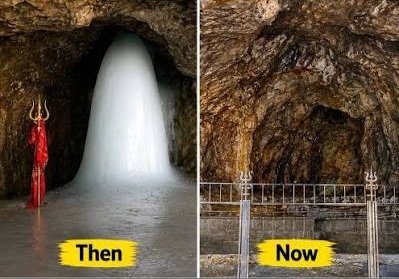
The profile of the pilgrimage has risen steadily .. What made it more attractive was the overall spiritual appeal of a natural snow stalagmite—the Shivlingam, revered as an icon of Lord Shiva in the cave shrine at a height of 13,800 feet—along with the added charm of Kashmir’s spellbinding beauty. Alongside this, langars, or free community kitchens, also arrived. That made the pilgrimage more colorful and transformed it into a feast-feeding journey as well. By this time, the pilgrimage had already woven itself into the consciousness of the Indian nation. It was purely religious, and there were no political or ideological strings attached. Militancy changed the whole meaning of it.
Extraordinary facilities have been created for pilgrims, especially the aged and infirm, to enable all devotees of Lord Shiva to fulfil their wish to pay obeisance at the shrine.
Security for the Pilgrimage
It was in the 1990s that the government first thought of securing the route and ensuring the safety of the pilgrims. In the first year of militancy, a connection was drawn between the selective killing of Kashmiri Pandits in the Valley—which forced their exodus from their homes in an atmosphere of absolute terror and fear—and the Hindu pilgrimage. The threat was real, and steps had to be taken accordingly to secure the pilgrimage and the pilgrims. From then on, everything changed, and it has not reversed since.
With major focus on the security , the pilgrimage’s complexion has changed: security forces begin making preparations months in advance. This approach is guided by a heavy physical presence—better known as the “battalion approach,” which puts more and more troops on the ground—along with the extraordinary use of technology. This has also given rise to comparisons with previous years regarding the number of pilgrims visiting the shrine.
The messaging is very clear: Kashmir is safe for pilgrims passing through once-militancy-affected areas because of the presence of security personnel and political decisions aimed at integrating Jammu and Kashmir (J&K) into the national mainstream. This has delivered dividends; the number of pilgrims paying obeisance at the shrine has increased significantly. In the first five days of this year’s yatra, which commenced on July 3, more than 1.13 lakh pilgrims paid obeisance at the cave shrine. This number speaks to the huge popularity of the pilgrimage, its security arrangements, and improvements in connectivity from both the Pahalgam and Baltal axes.
Knowing and bowing to that faith is more important than anything else in the pilgrimage. Lord Shiva chose high mountains because He wanted the Himalayas, and all the blessings they hold in their lap, to be respected as well.
Now that this year’s yatra has concluded for all practical purposes, there are vital lessons that must be learned to keep the true spirit of the journey alive for generations. The divine message was clear when the Shivlingam melted in the very first week of the pilgrimage—whereas, not many years ago, it used to remain in its divine shape until the very last day of the yatra.