

Sajjad Bazaz
A calendar is much more than just dates and days. There is a meaning hidden behind the name of every single month. While January signifies a fresh beginning, December marks the finishing point. Similarly all the months have their own significance. In fact, each month month has its own historical perspective that has shaped the way we live and celebrate today. From the ancient civilisations that first marked the passing of time to the modern traditions that have evolved over centuries, each month has its own story to tell. In other words, there are historical perspectives of each month, uncovering the origins of holidays, exploring cultural traditions, and discovering the events that have shaped our calendar.
Here, we will particularly talk about the month of October. Generally speaking, the month of October is the period of autumn when nature surrounds itself with different colours.
In the historical context of Jammu & Kashmir (J&K), the month of October is arguably the most defining month in the modern history of the region. After India and Pakistan became two different countries in August 1947 through a partition, it was J&K which witnessed the geopolitical destiny of the region permanently rewritten. The series of events that transpired during this single month (October 1947) transformed J&K from a sovereign princely state into an integral part of the democratic fabric of India, though the region saw some of its part annexed in war between India and Pakistan.
In other words, as recorded by historians across the globe, the month of October holds unparalleled significance in the socio-political and historical landscape of Jammu and Kashmir. Following the partition of British India in August 1947, princely states were given the choice to join either India or Pakistan, or remain independent. The ruler of J&K, Maharaja Hari Singh, initially chose to remain independent and sought standstill agreements with both dominions. However, the peaceful status quo shattered in October 1947 when the region faced a massive external aggression. Precisely, the events that unfolded during the month of October 1947 such as the choices made, the battles fought, and the treaties signed shaped the contemporary borders, politics, and identity of the region.
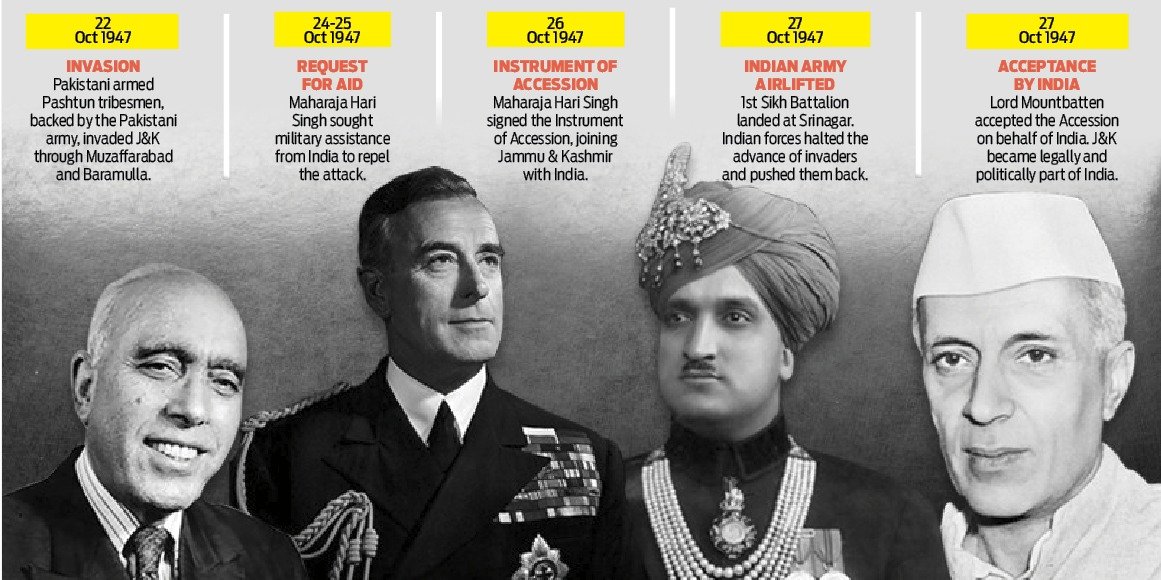
Ugly situation hit the independent princely state of Jammu & Kashmir, run by Maharaja Hari Singh, when on October 22, 1947, Pakistani armed Pashtun tribesmen, heavily backed and directed by the Pakistani military, crossed the borders and invaded it. Historians have recorded that the invaders advanced rapidly through Muzaffarabad and Baramulla, leaving a trail of widespread destruction, looting, and violence. The state forces under Brigadier Rajinder Singh fought valiantly but were vastly outnumbered. With the invaders fast approaching the capital city of Srinagar and the state machinery facing imminent collapse, Maharaja Hari Singh turned to the Government of India for urgent military intervention to protect his people. It’s recorded in the history that Pakistan carried out the aggression through armed tribesmen with the support of its regular army though a well-planned military operation code named Operation Gulmarg.
In response to Maharaja Hari Singh’s request for military aid to repel the attack of tribesmen backed by the regular Pakistani army, India agreed to provide conditional military support. Here it was a turning point in the history of J&K, as India asked Maharaja Hari Singh to formally join the Indian Union. As the time was not on the side of Maharaja, as armed tribesmen were fast invading the parts of Jammu & Kashmir, causing death and destruction in the region, It was on October 26, 1947, Maharaja Hari Singh signed the historic Instrument of Accession.
Historians have recorded this accession document as identical in framework to the ones signed by other princely states joining India, transferring the jurisdiction of Defence, External Affairs, and Communications to the Indian Parliament. The agreement was formally accepted the next day, October 27, by India’s Governor-General, Lord Mountbatten. So, it was on October 27, 1947, Jammu and Kashmir legally and politically got integrated into the control of India.
Immediately after the instrument of accession was formalised with Maharaja Hari Singh signing it on October 26, 1947 and India accepting the Accession, the Indian military jumped into action. On the morning of October 27, 1947, troops of the Indian Army’s 1st Sikh Battalion were airlifted to the Srinagar airfield. Alongside the Indian military, local Kashmiri volunteers – most notably figures like the young Maqbool Sherwani, who gave his life to delay the advance of the invaders – rose up to defend their homeland (J&K). It was the swift action of the Indian Armed Forces that halted the advance of the tribal raiders and successfully pushed them back from Srinagar. The Indian military action is believed by the historians to have altered the course of the subcontinent’s military history.
Even after 79 years (1947 to 2026), the historical weight of the month of October continues to reverberate in Jammu & Kashmir even today.
October 26 is celebrated as Accession Day across the region. In 2020, it was officially declared a public holiday in J&K, marked by national flag hoisting, rallies, and celebrations commemorating the region’s formal integration with India.
As a triumph of integration, certain regional political factions in the region historically observe October 22 (the day of the invasion) as a “Black Day.
Adding to the month’s historical significance, on October 31, 2019, following the abrogation of Article 370, Jammu & Kashmir officially transitioned into a Union Territory, bringing another massive shift to its administrative history in the very same month.
To be precise, the month of October has been highlighted by the historians and close-watchers of the tremendous fall out of the event since October 1947, as the crucible in which the modern destiny of Jammu and Kashmir was forged. As stated by the historians, particularly the Kashmir experts of repute, from the dark days of the tribal invasion to the historic signing of the Instrument of Accession and the subsequent deployment of Indian troops, the events of late October 1947 permanently bound the future of J&K to India. It stands as a month of profound reflection on diplomacy, sacrifice, sovereignty, and the complex geopolitical legacy that continues to shape Jammu & Kashmir.