

“Until you make the unconscious conscious, it will direct your life and you will call it fate.”
– Carl Jung

Anil Kumar Sharma
Human behaviour is often explained through logic, reason, and conscious choice. We tend to believe that the decisions we make, the opinions we hold, and the reactions we express are products of thoughtful reflection. Yet a deeper look into the workings of the human mind reveals that much of what we think and do is quietly influenced by forces operating beneath our awareness, the unconscious mind.
The conscious mind is the visible layer of our thinking. It analyses, questions, and makes deliberate choices. Beneath it lies the unconscious mind, a vast reservoir of memories, impressions, cultural beliefs, childhood experiences, and narratives that accumulate gradually over time. These impressions silently guide our perceptions of people and events, often without our realizing it.
The father of psychoanalysis, Sigmund Freud, argued that human behaviour is often shaped by hidden psychological forces. Later thinkers such as William James observed that much of our behaviour gradually becomes habitual and automatic, moving beyond the direct control of conscious thought.
In everyday life, the influence of these unseen impressions becomes evident in the way individuals and societies form opinions.
From childhood onward, our understanding of the world is shaped by the stories we hear, the conversations around us, the narratives circulating in society, and increasingly the content we consume through media and technology. Families, neighbourhoods, schools, and social groups become the first platforms where these narratives take root.
Growing up in Jammu and Kashmir, I too absorbed many such impressions about people and events around me. In small towns and closely connected communities, stories travel quickly. Sometimes they are shaped by admiration, sometimes by speculation, and often by simple street gossip. Over time these stories begin to assume the character of accepted truth within the collective memory of society.
There were certain personalities in public life whose names we frequently heard while growing up. The images we formed of them were largely constructed through what people around us said about them, discussions in markets, opinions expressed in social gatherings, and interpretations shared through local conversations.
As children we rarely questioned these narratives. They quietly settled into our unconscious mind and began shaping our perceptions. Without ever meeting those individuals or understanding their real journeys, we formed impressions that felt natural simply because everyone around us seemed to share them.
This phenomenon is not unique to any one place. It occurs everywhere in society. Narratives repeated often enough gradually acquire the weight of truth.
In earlier decades, when information moved slowly and access to authentic sources was limited, such impressions often remained unchallenged. The unconscious mind absorbed them and preserved them as part of our mental framework.
But the world has changed dramatically in recent years.
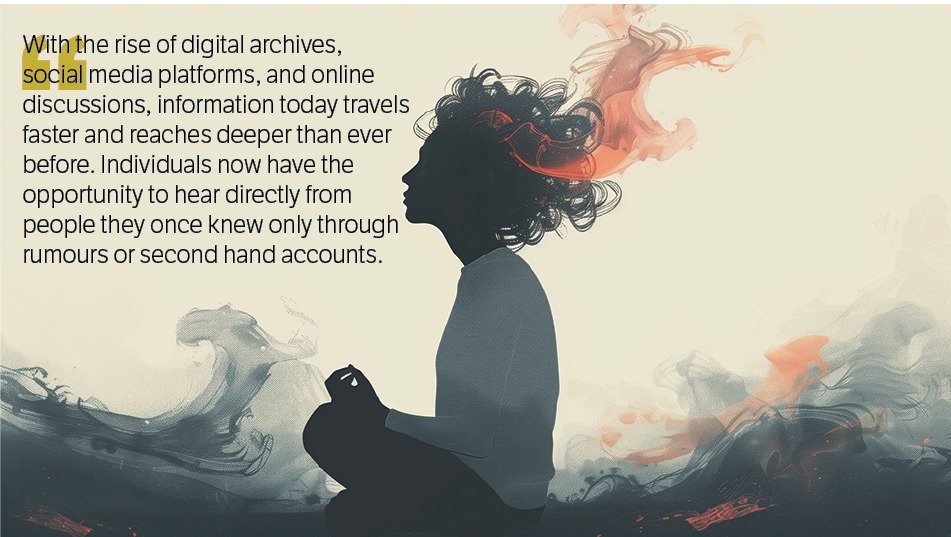
With the rise of digital archives, social media platforms, and online discussions, information today travels faster and reaches deeper than ever before. Individuals now have the opportunity to hear directly from people they once knew only through rumours or second hand accounts.
When we allow learning and personal observation to guide our thinking, the mind gradually evolves. The unconscious narratives of the past begin to transform into more thoughtful and compassionate perspectives.
I personally experienced this shift when I later had the opportunity to read about and observe some of those very personalities whom I had earlier known only through social narratives. Listening to their speeches, reading their writings, and observing their contributions through reliable sources gradually reshaped my understanding.
What once appeared as distant or even controversial figures through the lens of street conversations now emerged as individuals with complex journeys, struggles, and achievements. Reality turned out to be far richer and more nuanced than earlier narratives had suggested.
This process offered a fascinating example of how the conscious mind can gradually reshape the unconscious.
Learning, observation, and direct engagement began to challenge earlier assumptions stored deep within the mind. Slowly the unconscious impressions formed during childhood began to give way to more informed and balanced perspectives.
It felt like revisiting an old painting and discovering colours that had remained hidden in dim light.
In my own experience, interacting with diverse people, reading more widely, and observing events more closely has often reshaped opinions that were once formed unconsciously. What once seemed certain now appears more complex and layered.
This realization also revealed a broader truth about society. Many of the beliefs we hold about people, communities, or institutions are shaped not by direct experience but by repeated narratives circulating in our environment.
Media, social conversations, and public discourse all contribute to these narratives. In the modern age, social media has amplified this phenomenon dramatically. A single story repeated often enough can shape the perception of thousands, sometimes without adequate verification.
The unconscious mind absorbs these narratives quietly and integrates them into our worldview.
Yet human beings also possess the remarkable ability to reassess and evolve. When the conscious mind engages with new knowledge, it gradually begins to question earlier impressions. This transformation does not happen instantly. It unfolds through curiosity, exposure, and reflection.
In many ways, this ability to revisit our beliefs is one of the greatest strengths of the human mind. It allows societies to mature and individuals to grow intellectually and emotionally.
In my own experience, interacting with diverse people, reading more widely, and observing events more closely has often reshaped opinions that were once formed unconsciously. What once seemed certain now appears more complex and layered.
Such experiences remind us to remain humble in our judgments. Behind every public image lies a human story that cannot always be captured through casual conversations or fragmented narratives.
The conscious mind, when nurtured through learning and reflection, becomes capable of illuminating these deeper truths. It helps us move beyond stereotypes and simplistic interpretations.
In a rapidly changing world where information travels instantly and opinions form quickly, the balance between conscious awareness and unconscious influence becomes even more important.
Perhaps wisdom lies not in claiming certainty, but in remaining open to understanding.
When we allow learning and personal observation to guide our thinking, the mind gradually evolves. The unconscious narratives of the past begin to transform into more thoughtful and compassionate perspectives.
Perhaps this inner journey can be captured in a few reflective lines:
Bachpan ki suni baaton se tasveer bana li humne,
Logon ko afsaanon mein kahin kho diya humne.
Phir waqt ne seekh di – sach dekhna zaroori hai,
Har shakhs ko samajhne ke liye paas jaana zaroori hai.
Jab soch ne seekha dekhna apni aankhon se,
Tab jaa ke badli kahani jo zehan mein basi thi saalon se.
(The author is Times Link Bureau Chief , Jammu)