

Ayub Javaid
The political landscape of Pulwama is a fascinating study of transition, resilience, and transformation. From the foundational governance of veteran political giants to the aspirations of a new digital-age generation, this constituency has evolved through decades of regional turbulence, shifting loyalties, and renewed hope. At the heart of this sweeping historical narrative lies a legacy that stretches from the visionary, early development-focused era of the late KhawajaSonaullah Dar to the newly elected young leader, Waheed ur Rehman Parra, who now carries the massive weight of public expectation.
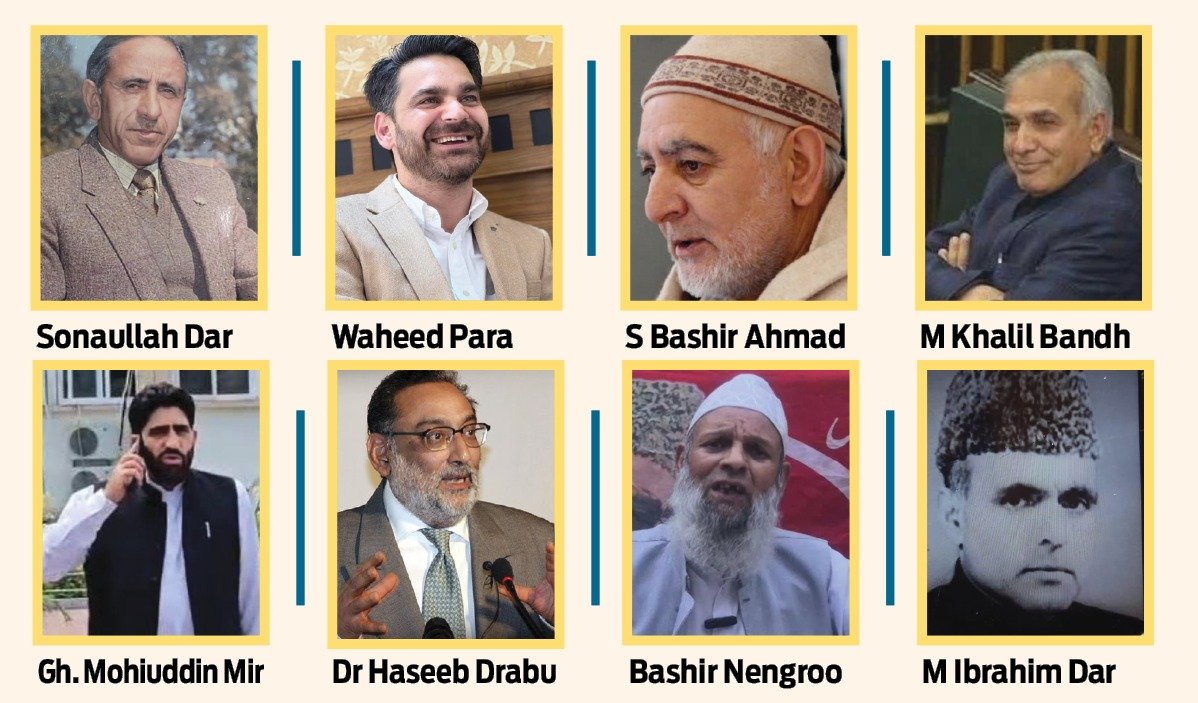
To understand Pulwama’s present, one must trace its journey back to the genesis of its progress under KhawajaSonaullah Dar, who remains one of the most revered and pragmatic politicians the soil of South Kashmir has ever produced. A law graduate from the prestigious Aligarh Muslim University, Dar’s political journey spanned an incredible six decades, marked by a deep commitment to social welfare and regional development. Though his very first electoral foray as an independent candidate in 1957 ended in a controversial defeat, where his family maintains he was denied victory despite securing an overwhelming majority of the votes; he eventually emerged as an influential lawmaker, winning the assembly seat in 1972 on an Indian National Congress ticket and later in 1983 as a National Conference contestant.
The turning point of his career came in 1984 during a volatile chapter in Jammu and Kashmir’s political history. By aligning himself with the late Ghulam Mohammad Shah alongside twelve other defecting National Conference legislators, Dar was appointed as the Cabinet Minister for Industries and Commerce. It was during this powerful eighteen-month tenure that he successfully administered his department and ushered in what many locals still remember as the golden age of industrial governance for the undivided Pulwama and Shopian regions.
Dar’s crowning achievement was the conceptualization, commissioning, and nurturing of the Lassipora Industrial Estate. What began as a blueprint under his watch has today evolved into a massive, multi-faceted economic engine housing over 540 active industrial units managed by an equal number of dynamic local entrepreneurs and business leaders. Operating at par with premier industrial zones like Rangreth, Zainakote, and Bari Brahmana, Lassipora has become a vital source of employment and income generation for nearly twelve thousand people. The estate serves as a robust manufacturing hub for a wide array of goods, including jute, leather, roofing sheets, and furniture, much of which is utilized locally or dispatched to other states across the country. Furthermore, the installation of nearly a dozen state-of-the-art cold storage units for apple preservation has transformed local horticulture, extending an invaluable safety net to orchardists and transporters against unpredictable climatic challenges.
Dar’s impact extended far beyond industrialization. He was a central figure among a galaxy of regional stalwartsincluding Mir Ghulam Hassan Pinglena, Ghulam Qadir Wani Niloora, Mohammad Ibrahim Dar, Mohammad Sultan Bhat, Mohammad Akbar Nengroo, Ghulam Qadir Mir, Abdul Qayoom Malik, Ali Mohammad Naik, and Mohammad Subhan Bhatwho together led a fierce public struggle in 1979. Amidst a mass uprising in the nearby tehsil of Shopian against the historical decision of Sher-i-Kashmir Sheikh Mohammad Abdullah to carve out Pulwama as the new district headquarters instead of Shopian, this collective leadership successfully ensured the commissioning of Pulwama district.
Throughout this journey, Dar’s willingness to align with different political factions occasionally drew criticism from his opponents. However, he possessed a rare, unapologetic clarity about his actions. When this author, working as a freelancer at the time, directly asked him why he frequently changed his party loyalties, Dar delivered a daringly brief response that left no room for further argument: “Well, that is not a religion.” It was this transparent, work-oriented pragmatism that earned him lifelong respect from both allies and ideological opponents, keeping his memory alive even eleven years after his passing into the eternal world.
The collapse of the Ghulam Mohammad Shah ministry in late 1986, following the withdrawal of support by Congress (I), brought Dar’s tenure as a cabinet minister to a conclusion and shifted Pulwama into a new, more complex era. In the highly controversial and fiercely contested assembly elections of 1987, Bashir Ahmad Nengroo, another law graduate, emerged victorious by securing over 23,000 votes. Evaluated as a junior minister in the subsequent National Conference administration, Nengroo’s political career was severely disrupted by the waves of armed turmoil that soon engulfed the valley. Yet, despite the prevailing chaos, he managed to leave an enduring mark by establishing the town’s Fruit Mandi, which remains a bustling source of income for scores of growers and transporters, and engaging numerous deserving local women as Anganwadi workers.
In assembly elections of 1977 Mohammad Ibrahim Dar of village Drabgam was elected as MLA whose laudable contribution to society include up gradation of road links and electrification of uncovered villages in the area. During split in NC leadership in 1980 Mohammad Ibrahim Dar joined Inqilabi National conference led by Mirza Mohammad Afzal Beigh and later played a key role in formation of national conference Khalida group headed by Gh Mohammad Shah.
Following the watershed events of 1987, democratic processes in the valley entered a long lull, heavily marred by boycott politics and minimal public interest. Subsequent elections held in 1996, 2002, 2008, and 2014 rarely witnessed voter turnouts crossing ten to fifteen percent due to frequent boycott calls by militant organizations. During this restrictive era, Mohammad Khalil Bandh emerged as a dominant figure, serving three consecutive terms as MLA from 2002 to 2019 under the People’s Democratic Party before eventually migrating to the National Conference. Bandh’s legislative footprint in the district is primarily remembered for expanding rural road networks under the PMGSY scheme and establishing the Government Degree College for Women in Pulwama.
While Pulwama town steered these shifts, the adjacent constituency of Rajpora was charting its own developmental trajectory. Represented over the years by Ghulam Mohi-ud-Din Mir of the National Conference, Syed Bashir Ahmad of the PDP, and later by the prominent national economist Dr. Haseeb Drabu, Rajpora witnessed substantial infrastructural growth. The combined efforts of Syed Bashir and Ghulam Mohi-ud-Din Mir led to the construction of several vital bridges over the RomshiNallah, successfully linking the Pulwama and Budgam districts. They also established regional Fruit Mandis at Pachaar and Drabgam, a Government Degree College at Rajpora, a Sub-District Hospital, and essential fire service stations.
The constituency’s developmental narrative was further elevated by Dr. Haseeb Drabu, who utilized his administrative acumen to inject significant funding into upgrading schools, healthcare facilities, and road networks. Drabu is highly regarded by locals for transforming the scenic alpine landscapes of Sangarwani into a flourishing tourist hub and initiating the comprehensive renovation of the historic Mughal Sarai at Shadimarg, alongside launching vital bridge projects at Deeri, Yechgoze, and Drabgam. The current sitting legislator, Ghulam Mohi-ud-Din Mir, has recently reaffirmed his commitment to ensuring that all these pending multi-crore projects are successfully executed during his current tenure.
The historical undercurrents of the past four decades set the stage for a dramatic shift in the recent 2024 assembly elections. Marking a monumental turning point after thirty-seven years of subdued democratic participation, voters from Pulwama town and its surrounding villages shattered the status quo, turning out in massive numbers to exercise their franchise. Breaking away from the long shadows of boycott politics, the electorate delivered a thumping majority to Waheed ur Rehman Parra, the youngest-ever contestant to win the Pulwama assembly segment. The local youth, in particular, rallied behind Parra, viewing him as a leader uniquely suited to articulate their deep-seated aspirations for employment, modern development, and systemic change.
Stepping into this role, Parra has vowed to actively bridge the deep chasm between the common masses and the administrative establishment. His vision centers on reintegrating the youth into the democratic framework and ensuring the swift disposal of long-pending public grievances. He emphasizes that his immediate governance priorities include establishing easy road access to vital industrial, healthcare, and educational destinations, which he believes will provide relief to ordinary citizens while boosting the “immune system” of the local economy.
The general public maintains high expectations for this energetic leader, looking to him to generate fresh employment avenues, commission a dedicated separate maternity hospital, develop public parks as in case recently got approval and started execution of Womens Park at Sirnoo, expand tourist resorts, and address complex regional reservation issues alongside daily necessities like a stable electricity supply, clean drinking water, and accessible healthcare.
The transition from campaign promises to active governance is already unfolding on the ground. The financial mobilization is underway, with more than four crore rupees already utilized from the previous year’s Constituency Development Fund. Furthermore, a budget of three crore rupees has been designated under Finance Commission works for the Roads and Buildings Department this year, clearing the way for the execution of roughly eighty distinct infrastructure projects, primarily targeting the vital lanes and by-lanes of Pulwama town.
From the foundational, industrial foresight of Sonaullah Dar to the vibrant, youth-centric mandate of Waheed ur Rehman Parra, Pulwama’s political arc reflects a society deeply eager for growth, stability, and democratic representation. While the challenges ahead are undeniably complex, the momentum for a transformed and prosperous Pulwama has officially been renewed.