

“As for the political opposition, they should accept the democratic mandate with maturity, introspect on their past governance mistakes, and play a constructive role in building a prosperous Jammu and Kashmir rather than manufacturing unnecessary controversies.”
Once you enter public life, one responsibility leads to another, and you must walk that path. If a person possesses a genuine passion to serve people, this field provides immense spiritual peace. Being in a position to mitigate someone’s suffering is a profound blessing.
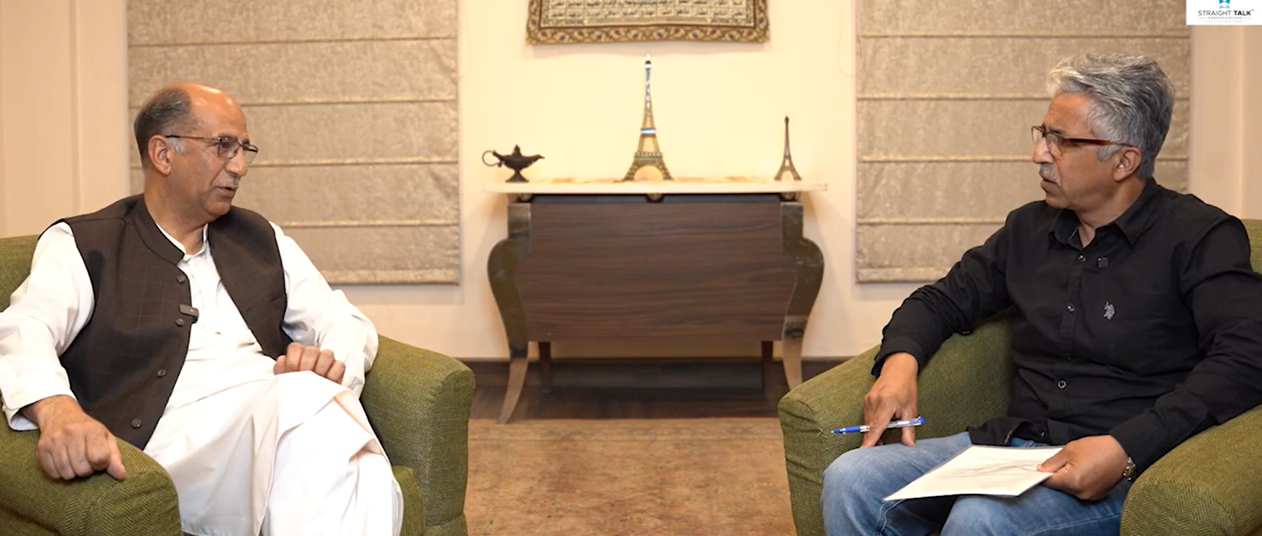
This is what Nasir Aslam Wani (NAW), Advisor to the Chief Minister, Union Territory of J&Ksaid among many other things in a Straight Talk session with TIMES LINK Editor, Sajjad Bazaz (SB). He is deeply aware of the ground realities here and has been closely observing the political landscape for a very long time. His grandfather also played a major role in the historic political struggle of Jammu and Kashmir.
NAW entered the legislative assembly in 2008 by winning the elections from the Amira Kadal constituency. In his very first term, he served as the Minister of State for Tourism and Culture, Revenue and Relief, PHE, and Urban Development. Early in his political journey, he was also entrusted with the crucial portfolio of the Home Department, which was an incredibly challenging responsibility at the time.
Here are the Excerpts of the conversation:
SB: Tell us briefly about your early life, your childhood, your schooling etc?
NAW: I was born in Sogam, Kupwara, but we have been living in Rajbagh for a long time. In fact, we were among the first residents of the Rajbagh area. You might be surprised to know that I initially studied at Presentation Convent School. At that time, the lower classes at Convent were co-educational.We shifted from there after the 4th grade because after that point, it became an all-girls school. I then completed my schooling elsewhere and later joined my family business before venturing into a new business of my own.
All of this was going on until 1996, when the political process restarted in Jammu and Kashmir. As you know, my family has a deep history in politics. My grandfather was a member of the Constituent Assembly. He threw himself into the political movement in Kashmir at a very young age back in 1931.
SB: He was involved in the early political movement against the autocratic rule, correct?
NAW: Yes, he was deeply involved. He was so young that when he was arrested for the first time, the authorities actually released him because he was a minor. I believe he was only about 13 years old. As the environment at home was entirely political, it naturally left a massive impression on my mind. That environment is what eventually drew us into public life.
College Days and the “Rebel Nature”
SB: Do you have a specific childhood or college memory that you would like to share?
NAW: There were many incidents. When we joined college, we had the Pre-University Course (PUC) system.It was around that time that the 10+2 system was being introduced. Before that, students would clear their PUC and head straight into engineering or medical streams. I remember an agitation broke out over a certain student issue. We were young and didn’t really have a full grasp of the politics behind it, but we suddenly got swept up in it. For the first time, we witnessed a massive strike at S.P. College. Moving from a sheltered school life to college life was a massive shift. I think Professor Peerzada Ali Muhammad and later Satish Varma were heading things around that time.
During that agitation, almost all the boys in our class were rounded up and arrested. We didn’t even know what hit us! We were taken to the Police Control Room (PCR). Since we came from well-known families in the city, the police recognised us. Around 50 to 60 boys had been picked up. By evening, the police counselled us and gradually released everyone to their families. But that was the first time we experienced that inherent “rebel nature” of youth, the feeling that you can stand up against the establishment for a cause.
That youthful energy is still the same today; a rebel nature is almost built-in at that age. Young people aren’t afraid of consequences, and they don’t always understand the complexities of the world. Back then, we used to think, “What is experience? No one has the knowledge we have.” We felt our parents were just imposing their opinions on us. It is only when you grow past that age that you truly understand how vital experience is in life.
Choosing Politics Over Engineering
SB: Looking back at that era when you were studying at S.P. College, there used to be an intense race among parents to turn their children into doctors or engineers. How did you choose the political field instead?
NAW: To be honest, during my PUC days, my family pushed me into the science stream because they wanted me to become an engineer. It wasn’t my personal choice; it was their wish. However, that was the year the system transitioned to 10+2. After the exams, I explicitly told my family that I did not want to pursue engineering. I completely changed my direction and shifted to commerce.
SB: And then you changed college?
NAW: Yes. At that time, the commerce stream was highly sought after in Islamia College, so I went there. After graduating, I intended to pursue an MBA outside the state. But during that interim period, I set up an industrial unit in Khanmoh and my focus shifted toward business.
In fact, back then, Kashmir University didn’t offer a full-fledged MBA program yet; they only had a DBA (Diploma in Business Administration). We had initially applied for an M.Com, but when the management diploma opened up, our neighbour, Mr. Rashid—who was the Head of the Commerce Department—guided us. We joined that course because it allowed the flexibility to manage a nascent business while continuing education.
Today’s youth live in a global village; they have immense awareness, better facilities, and endless avenues. Let me share a funny anecdote: when I first sat for an MBA entrance test, I had never even seen a multiple-choice question paper before! We had to answer 220 questions in 200 minutes. I remember when I came back home, my friends and acquaintances wanted to meet me, not because I had achieved something miraculous, but because they simply wanted to see what an MCQ paper looked like! Today, the youth have that entire world available at the click of a button. I pray that the new generation utilizes these digital facilities in a positive and constructive way.
The Transition to Public Service
SB: Given your background in business and entrepreneurship, what was the turning point that brought you completely into politics?
NAW: As I mentioned, politics was always part of our household ecosystem. After 1996, when the democratic process resumed in Jammu and Kashmir, a series of elections took place. We began participating actively in those campaigns. As the political process gained momentum, Mr. Omar Abdullah entered the scene. He won the Parliamentary elections first in 1998, and then again in 1999.
We all rallied around him, assisting in his campaigns. Around the same time, the Youth National Conference (YNC) was organised. Mr. Omar became the youth president, and a core group of 5 to 8 of us became office-bearers alongside him. Politics, they say, is a one-way street. There is rarely a way back. Once you enter public life, one responsibility leads to another, and you must walk that path. It has been an incredible learning experience. By the grace of Almighty, we don’t view politics through a cynical lens. If a person possesses a genuine passion to serve people, this field provides immense spiritual peace. Being in a position to mitigate someone’s suffering is a profound blessing.
Handling the Critical Home Portfolio
SB: During your political journey, you held the incredibly sensitive portfolio of the Minister of State (MoS) for the Home Department. The security situation at that time was highly volatile. Tell us about your experience managing that responsibility.
NAW: It was far more challenging than it was prestigious. Following the intense unrest of 2010, when the government was stabilising in 2011, the Chief Minister called me and stated he was entrusting me with this responsibility. Initially, I was extremely anxious because the ground situation was highly precarious. But he reassured me, saying, “We are standing right behind you, we will guide you, but you must step up and take this responsibility.”
By the grace of God, we worked tirelessly. That period turned out to be remarkably successful. If you recall, the years 2011, 2012, and 2013 saw a massive revival in tourism and a significant stabilisation of the overall security environment. However, the Home Department is inherently a bed of thorns. In Jammu and Kashmir, almost every aspect of governance and public peace relies on the responsiveness of this department. It is always the first responder.
SB: Did you have any harrowing or deeply negative experiences during your tenure as Home Minister?
NAW: There were numerous security incidents that were incredibly difficult and agonising to handle. It was a constant tightrope walk. But we stayed focused, and public memory appreciates that we tried our level best to maintain peace with a human touch. The Chief Minister himself closely monitored everything as the Cabinet Minister for Home. The institutional support I received from him allowed me to function effectively despite it being my first time handling such a massive apparatus.
The Legacy of the National Conference
SB: When we look at your family’s political lineage, some suggest your grandfather was briefly associated with the changing leaderships of that era. What is the actual history, and what drew you so strongly to the Jammu & Kashmir National Conference (JKNC)?
NAW: No, my grandfather was always ideologically aligned with Sher-e-Kashmir (Sheikh Mohammad Abdullah) and the core Kashmiri movement. Later on, when institutional changes occurred in the government, he was part of the Bakshi Ghulam Mohammad ministry, but it was under the banner of the National Conference platform of that era.
You see, the National Conference was never just a mere political party; it was a socio-political movement. No matter how much critics lambast it today, its foundational contributions to Kashmiri society outweigh any criticism. The biggest achievement of the party was that it began as a movement for an enslaved, impoverished population living under oppressive systems like Chakdari (feudal landlordism), Soodkhori (usury), and Jagirdari.
To raise a voice against an absolute autocratic regime was no small feat. The National Conference gave a definitive voice to the subjugated people of Kashmir. When public governance was established, the most revolutionary step taken was the Land to the Tiller policy, implemented without paying any compensation to feudal landlords. There is parallel to this radical land reform nowhere else in the developing world. It turned ordinary peasants into landowners overnight, not just in Kashmir, but across Jammu as well. If the marginalised and backward classes in J&K live with dignity today, it is because they were given economic ownership of their land.
SB: People frequently credit Sher-e-Kashmir Sheikh Mohammad Abdullah for those historic shifts. But what is the contribution of the contemporary leadership of the JKNC?
NAW: Look, the eras are completely different, and the challenges cannot be compared. No one can stand in direct comparison with the stature of Sher-e-Kashmir. But look at how the subsequent leadership kept this region intact. Take Dr. Farooq Abdullah, for example. You cannot ignore his role. In 1996, when the entire region was consumed by absolute chaos and bloodshed, nobody was willing to step forward to form a civilian government. Today, leaders make grand claims and give fiery speeches, but in 1996, it was Dr. Farooq Abdullah who stepped up to revive the democratic structure and save the administrative fabric of this nation.
By 1996, the entire infrastructure had collapsed. We had no functional hospitals, schools were burnt, roads were destroyed, and the administrative system was non-existent. Dr. Farooq Abdullah brought the train back on the tracks. Within a few years, the road networks were rebuilt, healthcare systems were re-established, and schools were reopened in the most remote areas.
Addressing Past Controversies and Political Shifts
SB: While Dr. Farooq Abdullah revived the political structure in 1996 after it was derailed by militancy, critics often point out that his tenure also saw severe counter-insurgency operations, human rights excesses, and the rise of groups like the Ikhwan. How do you respond to that?
NAW: The anti-insurgency campaigns and the breakdown began long before 1996—around 1989 and 1990. What critics conveniently ignore is that after 1996, a public face was given to governance, and institutional accountability was gradually restored. There was a deliberate, systematic propaganda campaign launched against him to ensure that every systemic failure was blamed solely on Farooq Sahib.
A specific political outfit emerged in the late 90s whose sole agenda was to tarnish his image. Consequently, our party lost the 2002 elections. But look at what followed. From 1989 to 1990, the challenge was armed militancy. But during the tenure of the government that succeeded us, ordinary citizens were pushed to the streets as agitators, most notably during the 2008 Amarnath land row. They turned the youth into mass agitators, a cycle that continued through 2009 and 2010. Their primary objective was always to destabilise governance rather than build infrastructure.
SB: Moving to the recent 2024 Assembly elections, the National Conference received an overwhelming mandate across J&K. However, you shifted your base from Lolab to a city constituency and faced a setback. What went wrong? Did the voters reject Nasir Aslam or the party’s narrative?
NAW: There were multiple factors. I previously represented and worked extensively in the Amira Kadal constituency (now bifurcated/redrawn). During my tenure, I built 10 to 12 community halls, established primary health centers, constructed a full-fledged hospital in Chanapora, built state-of-the-art sports infrastructure like the Gindun Park, and executed drainage projects worth crores in low-lying areas.
Following the recent delimitation, constituencies were drastically redrawn. My native roots belong to the Kupwara district, and there was a strong demand from the party cadre and my old family associations to contest from the Lolab/Kupwara belt. I wanted to return to my roots and serve that area. Unfortunately, the electoral math didn’t go in our favor this time.
SB: Any specific reason for the loss?
NAW: In a democracy, you must accept the mandate with humility. Perhaps the voters in that specific constituency felt the opposing candidate was a better fit for their immediate needs at that moment.
Delivering on the Manifesto and Statehood
SB: Do voters today vote for a party’s overarching ideology or for the individual candidate?
NAW: It is a combination of both. The Kashmiri voter is highly sophisticated; they vote after analysing what serves their socio-political interests best. The National Conference is a grassroots, organic movement—it is not an overnight creation of any external agency. Many small and large political factions pop up here routinely with external backing, primarily designed to split our vote share and weaken our stance. But the people eventually return to the National Conference because our roots are tied to this soil.
SB: Speaking of the 2024 elections, the JKNC manifesto promised widespread economic and social relief. However, now that the party is in power, critics complain that many promises are being delayed under the pretext of waiting for the restoration of full “Statehood. Why wasn’t this condition explicitly highlighted in the manifesto before elections?
NAW: A party’s election manifesto is a comprehensive roadmap meant for a full five-year governance term—it is not a 10-day or a six-month checklist. How can anyone expect every single structural promise to be fulfilled within the first few months?
Despite the immense administrative limitations of being a Union Territory, Chief Minister Omar Abdullah has already implemented several key welfare measures without giving excuses about statehood. For instance, free transit initiatives for women, increasing the ration scale for marginalised families, and providing basic utility relief. More importantly, the very first legislative assembly session passed a resolute historical resolution demanding our constitutional guarantees and statehood back.
We have still time to execute our promises, and we stand committed to fulfilling them. Some structural and financial matters will naturally require us to navigate the complexities of our current administrative setup, but work has already begun.
SB: But when I spoke to your Member of Parliament, Aga Syed Ruhullah Mehdi, he pointed out that the restoration of statehood was embedded as a prerequisite for several long-term changes. Isn’t there a contradiction between your statements?
NAW: There is no contradiction. I was a member of the manifesto drafting committee myself. If we hadn’t initiated any welfare programs, critics would be justified in saying we are using statehood as an excuse. But we have started implementing our promises. You must acknowledge that J&K is currently a resource-stressed territory heavily reliant on central funding. Within these tight fiscal constraints, the budget presented by Mr. Omar Abdullah’s administration is exemplary. We have managed to initiate major welfare schemes within a limited fiscal space, and its scope will expand in the upcoming fiscal years. Within the next two to three years, our developmental targets will be fully visible on the ground.
Internal Democracy Within JKNC
SB: You mentioned internal alignment, but MP Ruhullah Mehdi has stated on record that not everyone in the party is on the same page regarding certain political strategies. Is there a lack of cohesion inside the JKNC?
NAW: We are a democratic political party operating within a democratic system. Are you suggesting we should function like a rigid dictatorship where every single leader must toe a singular line without any internal debate?
On the contrary, the public should appreciate that the National Conference accommodates different schools of thought and encourages vigorous internal debate. In our organization, leaders have the right to dissent and express variance of opinion internally. It is a sign of a robust, healthy internal democracy. A strong party possesses the resilience to debate opinions internally but ultimately stands united once a collective leadership decision is finalized.
Security, Geopolitics, and Permanent Peace
SB: Let’s look at the current security situation. What are your thoughts on the recent tragic security incidents in Pahalgam and the subsequent operations?
NAW: The violent incidents in Pahalgam were deeply unfortunate and tragic. Such acts of violence undo years of peace-building efforts. However, the silver lining this time was the spontaneous, unanimous condemnation from every single community, religion, and political ideology across Kashmir. The society stood united against this brutality.
Kashmiris came out in thousands to send a loud, unambiguous message to the world: This violence is not being done in our name, and we do not support the murder of innocent people. Our religion explicitly forbids the killing of innocents. The victims were our guests who came here to contribute to our economy. I don’t think there was a single sensitive person here whose eyes didn’t wet up with tears when that tragedy occurred.
SB: Following those incidents, we have seen a rise in sharp political rhetoric and border tensions. As someone who has travelled extensively across border areas, what is your perspective on this?
NAW: War or aggressive posturing is never a solution. Those who sit in comfortable, air-conditioned television studios in Delhi presenting war as if it were a festive sports event do not understand the sheer devastation of conflict. They don’t know what it feels like to live on the border when heavy artillery shelling starts.
I have toured those border areas extensively alongside the Chief Minister. The trauma of families—mothers, children, and the elderly packed into claustrophobic underground bunkers while shells rain down from the sky is horrifying. It is an absolute miracle that our border populations survive such cycles of escalation. War brings nothing but misery. We must preserve the ceasefire agreements at all costs, regardless of the warmongering narratives peddled by certain media anchors.
SB: Recently, the Chief Minister raised concerns regarding the financial losses J&K incurs due to the restrictions imposed by the Indus Waters Treaty (IWT). This has stirred up a massive political controversy. What is your take on this?
NAW: Our position on the Indus Waters Treaty has been entirely consistent for decades. J&K has historically borne the brunt of financial and energy losses because the treaty restricts us from fully utilising our own water resources for major hydroelectric generation or extensive storage irrigation.
We have never advocated for physically stopping the water flow to the neighbouring country. We are simply pointing out that this treaty was signed decades ago without consulting the stakeholders of Jammu and Kashmir. If our developmental and energy potential is restricted because of an international treaty, then the Government of India must adequately compensate J&K for these structural losses.
When the Chief Minister highlights this issue during his meetings with the Prime Minister to seek fiscal compensation or remedial energy packages, certain quarters deliberately twist it to sound like warmongering. What does talking about our economic rights have to do with warmongering? We are simply saying that we should be allowed to run run-of-the-river power projects—like Baglihar—where water is utilized to generate electricity and then flows back naturally into the river system. We aren’t cutting off anyone’s water; we are merely asking to quench our own thirst.
SB: Do you think there is any scope for redrafting or reviewing the Indus Waters Treaty?
NAW: That is an international bilateral treaty completely within the jurisdiction of the Union Ministry of External Affairs. It is outside the scope of a state government. We leave it to the Government of India to make diplomatic decisions on that front. However, as representatives of the people of J&K, it is our duty to consistently remind the Center of the financial losses we suffer because of it, and ask for fair compensation.
A Vision for the Future
SB: Decades of conflict and uncertainty have taken a massive toll on our society. Our generation has grown up seeing nothing but instability. What, in your mind, is the permanent path to peace?
NAW: This prolonged uncertainty has damaged our economy and psyche far more than anything else. We are of the same age,and we both know the heavy price our generation paid. We want a future where our children can live a normal, predictable life free from fear.
In an environment of constant uncertainty, no entrepreneur can plan a business venture, no institution can plan ahead, and society feels like a constant game of snakes and ladders. The entire world has moved on; global powers like the US and developing nations are focusing entirely on trade corridors and economic growth. Meanwhile, we have spent decades struggling for basic survival.
The neighbour—Pakistan—must understand that their policy of fuelling militancy over the past 35 years has yielded nothing but destruction. J&K historically rejected the two-nation theory in 1947, and we want to progress peacefully within the constitutional framework.
SB: What are the key areas you personally want to focus on to turn this vision into reality?
NAW: There is an immense amount of work to be done. My heart wants to focus heavily on structural development and creating sustainable avenues for our youth. It is impossible for the government to provide a state job to every single individual; therefore, we must build a robust ecosystem for private enterprise, startup culture, and industrial growth so our brilliant minds don’t face immense mental pressure or leave the country in a massive brain drain.
We need to drastically upgrade our healthcare infrastructure and our higher education system. Every year, we see a massive flight of both capital and human talent because students go abroad or to other states to pursue professional degrees. They adapt to those environments and rarely return, which bleeds our society of its best talent. We need to encourage high-quality private universities, top-tier medical institutions, and world-class tourism infrastructure right here in J&K.
It often feels like we take one step forward and two steps back due to unforeseen disruptions, but I have absolute faith in the resilience of our people and the grace of the Almighty. The situation will stabilise. As for the political opposition, they should accept the democratic mandate with maturity, introspect on their past governance mistakes, and play a constructive role in building a prosperous Jammu and Kashmir rather than manufacturing unnecessary controversies.