

“Kashmir is reduced to statistics. It becomes a number in discussions about normalcy and peace, and a number in discussions about violence.Once you become a number for an officer or a government, your human value disappears. You become either a body bag or a prisoner number.”
From the paddy fields of Naira in Pulwama to the corridors of power and international platforms such as the Climate Conference in Paris, his journey has been anything but ordinary. Beginning as a journalist, evolving into an activist, and eventually earning a place in the Jammu and Kashmir Assembly, he has steered challenges, controversies, and even imprisonment while remaining a prominent voice for youth and public engagement. Known for his international exposure, attention to detail, and deep roots in his constituency, he now represents Pulwama as its MLA(Member of Legislative Assembly).
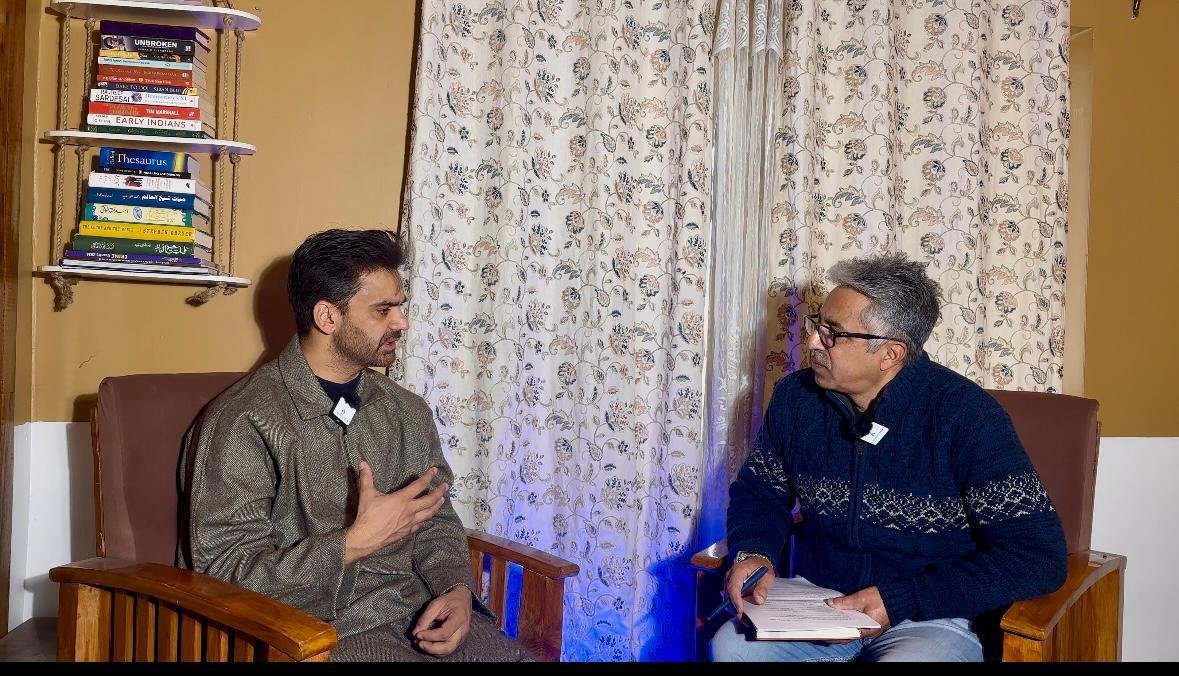
This is what describes Waheed Ur Rehman Parra (WRP). Despite his young age, he has a comprehensive understanding of Kashmir’s politics and state politics and has actively participated in both. In a Straight Talk Session with Times Link Editor, Sajjad Bazaz (SB), he shared insights into his life and the journey he has undertaken in such a short span of time.
Excerpts of the conversation:
SB: How did you achieve whatever you have achieved so far? How will you describe yourself?
WRP: Well, we are a young state. And living in Kashmir, being young, the casualties of this conflict were young. Whether in militancy, in stone pelting, in Jail, or in cases, it is the young who became the casualty. So, keeping these circumstances in mind, we also have similar emotions as a common Kashmiri youth.
We saw our classmates in cases, indulged in violence, lost their lives, many people died, many people were injured, many people lost their eyes, many people became victims of this violence in the last 30 years. So, I think, keeping that in mind, every person should have a desire to do something that will benefit the community, the youth, and youth energy, sentiments, emotions. I mean, it should be long-term, it should have an impact.
We should do something that will benefit us and our community. I think, keeping that in mind, I feel it’s the duty of every young Kashmiri to do things and spend time and energy in a way that creates some impact for the younger generation around us. So, I think, I also have a small role in that and we are trying to play that role in every forum.
SB: You come from a place that was prone to militancy, how come you did not become a one among them or how did you protect yourself?
WRP: Yes, I come from Naira Pulwama, a small village that exactly reflected the situation that was in Pulwama during peak militancy. So, as a young Kashmiri Muslim, our thoughts, my thoughts are same as that of common Kashmiri as well. And I have always been trying since childhood that our new generation should do something that young Kashmiris should live for Kashmir.
They should not die for it. That, I think, should be the core of what we are trying to do. And in that, I felt that somewhere or the other, the democratic process is a very important step.
That whatever you cannot get from pelting stones, going to jails, fights, guns, you should get it politically. We are in the 21st century, the largest democracy in the world. There will be challenges, difficulties, but whatever result-oriented work will be done will be done democratically.
So, keeping that sentiment in mind, I always had a desire that things should be navigated through the democratic process. And in that, I felt that since 2010, we have taken a little interest in this work. And in 2012, I joined the People’sDemocratic Party under the leadership of Mehbooba Mufti.
She was more open to young people joining politics and encouraging youth to be brought into this process. Because at that time, PDP was like a growing party. It had been 14 years since we had started working. So, by tapping that young energy, we did a lot of work. We tried to bring new people into the mainstream, into this process.
It was not about me coming alone or bringing a few people. The idea was to open gates and remove the stigma with the mainstream, with voting, with democracy, after 1987.
I just said that young Kashmiris should live for their place. They should not die for Kashmir. They should live for it and work on it.
This is a place where we can operate and help our society, help the cause of Kashmir also, help our economy also, help our place to co-exist. So, I think this is the best place where we can operate.
It is challenging because it requires a lot of patience. It requires patience. And you will get dividends very late. Keeping that patience in mind, we can actually work on things which help Kashmir in the longer terms.
SB: Was it an inspiration to go to the politics or was it due to the pain for Kashmiris? What was it between the two?
WRP: I think there are two things. There is suffering in every youth here. And those who despite being apolitical, they are also very highly political. Those who stayed away from the mainstream, they were more political people. A lot of people thought that violence would lead to politics. A lot of people thought that pain would lead to politics. So, there is a lot of trauma in this place. I think all of us are political because of the whole circumstances of this place. And because of those circumstances, even those who don’t want it, become political in many ways.
So, I think there is a lot of suffering here among the youth that we have to represent Kashmir, that we have to preserve it, that we have to talk about our nation, our people, our land. So, I also had that suffering somewhere, keeping that situation in mind.
But definitely, I think Mufti Sahib also had a concern because the way he changed the landscape of Kashmir politics, is that he made it more dignified to be part of democratic process. Till then, we thought that democracy is like dissent and is represented through violence, not through democracy. I think Mufti Sahib changed that whole narrative in 2002, where democracy can be dissent, democracy can be divergent, it can be disruption also, it can be development also, or it can be a dialogue also. And it is part of the dignity of Kashmiris as well. I think the definition that he opened is that democracy is not just a real estate issue or development, In fact, it is a matter of human dignity. And Kashmiris feel that human dignity has to be in sync with the political process, democratic process.
So, I think he changed that narrative and successfully carved out the dignity project out of democracy. And because of that, a lot of people joined a new class of democracy, and we also tried to take that view forward. Precisely, when Mufti Sahib came in, he changed the narrative in Kashmir – that to be a Kashmiri, to be a Kashmir’s representative, to be a Kashmiri’s representative, a Kashmiri youth doesn’t need to be a militant. He can talk about this in the Assembly as well. He doesn’t need to be a stone thrower.He doesn’t need to be a separatist. He doesn’t need to go to jail.
SB: Then why did you go to jail?
WRP: In the democratic process, you want to talk about your issues, about the solution of Kashmir, about dialogue and dignity, and about strengthening the democratic process. But there is a system which is hell-bent to call it an anti-India narrative. And they have always tried from 1987 till today to derail that process. Those people are outside as well as inside the system. And there is resistance among those people that we should not give this space to Kashmiris. I think that’s why a lot of people have suffered because from 1987 people who tried to be MLAs, who tried to be ministers, who tried to be part of the government, who tried to believe in the constitution, were pushed into graves and jails. I think it happens with us as well, it still happens with a lot of young people, that they are broken and shut down. We walk with a little patience.
I fought very legally while being in jail. There was a party behind me. There was a former Chief Minister Mehbooba Mufti Ji fighting my case. There was a full set-up of lawyers fighting my case. A lot of people don’t have those opportunities. They don’t get lawyers. And there is no one to talk to them. Thousands of boys are still in jail.
And these things increase anger, hatred, and alienation. Because jails here are very punitive, they are not reformative. So people get a lot of trauma from that. And they go away, not only from the country, from the democracy, but they go away from their lives as well. It becomes difficult to recover from there.
SB: You spent about three years in jail. What has changed in your life in these three years?
WRP: I think jail has brought me closer to the problem, closer to the sufferings of people, and also more closer to the whole idea of conflict in Jammu and Kashmir. That is how political things have a personal cost on the people of Kashmir. And like the youngsters who are in jail, no matter what we call them, for his family, he is not a militant, terrorist, separatist, pro or anti-India. Their child is in jail, and they are in agony. If 10,000 people are in jail, these 10,000 families are destroyed. Their parents are worried. Their siblings are worried. And it has a huge traumatic cost on their families.
I think we have nothing to offer to this constituency in Kashmir, which is a huge constituency because of conflict. There are 1 lakh families who have lost their children. Whatever the names we give. But if you come to the idea of reconciliation in J&K, the challenges to peace in J&K are these families. After going to jail, I understood this. They are still in pain. They are waiting for resolution of their problem, they are waiting for resolution of what they have lost. They thought their children have gone through jails, their lives have been destroyed.
So I think there has to be some dignified exit to this constituency, and within democratic framework, it is possible. I think the first thing is recognition of the pain. Second is acknowledgement of the challenges. And third is to compassionately how to run governance. We need to reach out on those factors, not as state government, central government, but as human first. We are in a lot of denial and think that everything is good. We think that there is peace, and suddenly we see a lot of differences, strife within strife. We have to understand that there is a lot of suffering and we have to be a lot more compassionate to people who have suffered here including the families who are not in sync with Indian thought or who are in sync with Indian thought. Overall, I think families have suffered a lot. Jail brings you closer to the whole pain, anger and sufferings of people of Kashmir.
SB: You talked about anger that jail brings anger. Do you have the anger as you have been there?
WRP: Well, I don’t, but I think a lot of people I met in jail are very angry. And that anger grows into anguish, hatred and those people then always think for revenge. I won’t say everyone, but most or some percentage.
SB: You yourself spent three years in Jail, there is a segment of prisoners, who have no one left to fight their case, who are downtrodden, or their parents are no longer in a position to support them legally, any plan to lend them any legal support?
WRP: I think definitely, inshallah in coming times you will see because there are institutions, government, law-making bodies and they should be doing this work.
I think our first role in a conflict place is also like there are some things that institutions are meant to do. Having spent time in jail, I developed a great appreciation for the courts, the law, bail, the criminal justice system, the jail manual, and prison reforms. So these are things that matter because, you know, the prosecution doesn’t do its job properly. The process becomes a punishment.
I think there need to be many legislative interventions. First of all, the criminal justice system must become effective, prisoners should receive timely hearings, and accused persons should not be treated as if they are already convicted.
An accused person may be innocent. In many cases, they are innocent people. So I think India needs major reforms in its criminal justice system.
This is not just a Kashmir issue. It is a problem across the entire country. If you look at the overall state of the criminal justice system in India, many people are suffering because bail is often denied.
The process itself has become the punishment. So, God willing, we are trying to work on this. We are working on it.
At present, the powers of the Assembly are very limited. But within those limitations, we will try to do whatever is possible.
SB: You had posted a tweet about your time in jail. Reading that tweet, I felt that it referred to something personal that had happened to you involving a senior police officer. Is that what it was about?
WRP: I think many people who work here, including officials who serve here from time to time, often take things very personally. They label us with names such as ‘OGW’ (Over Ground Worker), ‘hybrid militant,’ militant, and all sorts of other tags. Kashmiri young people have been given every possible label.
But when we were born, we weren’t born militants, separatists, stone-pelters, or OGWs. No child is born with such an identity. Kashmiri youth are among the most productive and capable young people in the country.
This was acknowledged even by India’s Home Minister, who, during a function in Pune in February 2023, said that Kashmiri youth are our ambassadors and can represent the nation across the world. That was an encouraging statement.
Despite enduring constant pain and hardship, we have competed in national-level examinations, delivered results, and achieved success in many fields. I think the people here are exceptionally bright and talented. It’s just that our circumstances often force people to take sides. Those circumstances can also make people aggressive or violent.
When, growing up, you witnessed crackdowns in your village and saw your parents being mistreated—whether by militants or by security forces—Kashmiris always responded to such experiences. Sometimes that response was called pro-India, and at other times anti-India.
I think some officers come here with very little understanding of the actual problem. They don’t view Kashmir from a human perspective. Instead, they see it through a security lens, a communal lens, or a nationalist and jingoistic lens.
To them, we have become statistics. We have become numbers. Whether it’s the number of pilgrims, tourists, militants, incidents, land attachments, or people arrested under drug-related laws, Kashmir is reduced to statistics. It becomes a number in discussions about normalcy and peace, and a number in discussions about violence.Once you become a number for an officer or a government, your human value disappears. You become either a body bag or a prisoner number.
Today they say, ‘We detained this many people under the NDPS Act, this many under the PSA, this many under the UAPA.’ But they don’t see that these are families, lives, and human beings.
God forbid, but when you imprison someone, you disrupt an entire family. You place that household into lasting hardship. You distance that person from the country, from the government, and from any sense of normal life. The consequences of such decisions can affect people for the rest of their lives.
Yet officers receive stars, medals, promotions, and rewards. There is a system that incentivises this kind of behaviour.
That is why I wrote the tweet you mentioned. It was directed at a particular individual who headed the police force in Jammu and Kashmir. He never seemed to look at the issue from the perspective of rehabilitation or healing. The approach was always suppression, force, and the belief that people could somehow be brought to their knees through fear.
They promoted what I call a graveyard peace.
We are not anti-India. We are also pro-country and pro-Constitution. But our idea of peace is that it must be sustainable, inclusive, and based on the will of the people. It should be a peace that people genuinely feel and participate in, not merely a peace imposed by the government.
The people of Kashmir should feel that they, too, can breathe freely within that peace.
Instead, situations are sometimes created where an outside tourist feels safe, while a local resident feels unsafe. That reflects a particular mindset.
Some people pursue medals and recognition at the cost of our lives and dignity. And that is precisely what we were trying to point out in that tweet.
SB: What would you suggest to the Government of India, or the current government, which you are also a part of as a lawmaker, to ensure that such situations are not repeated and that these issues come to an end?
WRP: I think Kashmiris are genuinely waiting for a compassionate outreach. We used to talk about a healing touch back in 2002, that was the vision of Mufti Sahib that Kashmir should be viewed with compassion, through the prism of humanity.
We often speak of humanity and democracy, but in Kashmir those ideas largely remained words. Unless the state opens its heart and shows greater magnanimity, things will not change.
SB: Do you mean that this approach is still absent on the ground?
WRP: When dealing with the youth of Kashmir, the approach remains highly codified and centered around force. Yes, there are some initiatives, opportunities, jobs, symbolic gestures, but much more needs to be done to win the hearts of the people of Kashmir.
SB: When we look at the past 30 years, the entire cycle of violence has resulted in social disorder. Society appears to be completely in the grip of social dislocation and instability. What is your understanding of this situation?
WRP: I think the social disorder you are referring to is also a consequence of prolonged political uncertainty. The political uncertainty that has persisted over the years has destroyed families. Many people are uncertain about their future, and even today they continue to feel insecure about what lies ahead. The events of 5th August created more confusion rather than resolving existing uncertainties.
Even the government itself maintains that the Union Territory status is temporary and that Jammu and Kashmir will eventually be granted statehood again. There are still many unresolved political issues, and these have created widespread anxiety among people because, ultimately, we are human beings and social beings. Such uncertainty has profound social, human, and psychological consequences.
This is what poor politics has done to Kashmir. As a political party, we place considerable emphasis on the political process, reconciliation, and dialogue because people are still searching for closure, as I have already mentioned. When discussing post-conflict reconstruction, there is a significant need in Kashmir for healing and rebuilding society. If you genuinely want to heal a society, you must first acknowledge the mistakes that have been made. Denial cannot work.
Unfortunately, we are still living in a state of denial—as a government and as a state. There are many realities that continue to be denied, and unless we acknowledge them honestly, meaningful progress will remain difficult. Just as an individual can only improve after recognising their shortcomings, a society can only heal after confronting its realities.
The social disorder we witness today has many manifestations. Delayed marriages are one example. Unemployment is another major factor. The failure of entrepreneurship, repeated shutdowns, hartals, and various other disruptions have all had a significant impact on society. These factors collectively contribute to widespread anxiety and uncertainty.
There is no doubt that we are a resilient society and that people continue to support one another during difficult times. However, despite that resilience, many people are still suffering.
SB: You spoke about statehood. What is your view on that? Do you think it will be restored?
WRP: I honestly do not know when it will be restored. However, all of us are on the same page when it comes to restoring the dignity that was taken away on 5th August, including Article 370, Article 35A, and statehood. The restoration of statehood cannot be the end of the process. In fact, it would only be the beginning of a larger political process.