

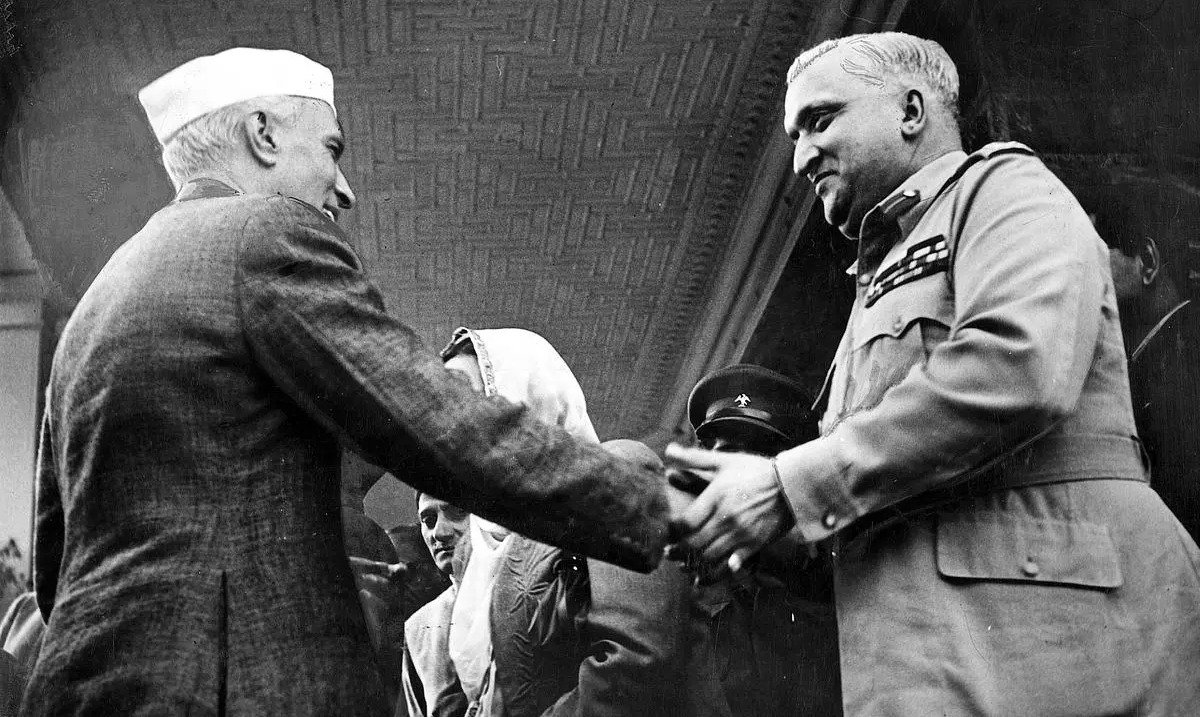
Jammu and Kashmir was a princely state before 1947. Its ruler, Maharaja Hari Singh did not want to merge with either India or Pakistan but wanted to have an independent status for his state. This sentiment was popular in Kashmir because they did not see themselves as Pakistanis or Indians but as Kashmiris above all. This issue of regional aspiration is known as Kashmiriyat.
In October 1947, Pakistan sent tribal infiltrators from its side to capture Kashmir. Due to the crisis that erupted in Jammu and Kashmir, Maharaja Hari Singh was bewildered. While the Government of India was keeping a close watch on the developments in the state. It was only on 24 October 1947; the Government of India received the first news of the invasion of Kashmir. Then on the same night at 1100 Hours an urgent request was received from Maharaja Hari Singh, specifically requesting Indian Government to send Indian troops to Kashmir to protect it from the invaders. The Defence Committee of the Cabinet discussed the situation and the urgent pleas of the state of Kashmir and popular leader Sheikh Abdullah for military assistance to halt the raiders in Kashmir. After several rounds of discussions, it was decided that Indian troops would be sent to Kashmir only after formal accession to India.
VP Menon (Secretary, Ministry of States, Government of India) flew to Jammu in the afternoon of 25 October 1947, and brought back Instrument of Accession, signed by Maharaja Hari Singh. With the acceptance of this legal document by the Governor-General of India on the evening of 26 October 1947, the state of Jammu and Kashmir became an integral part of India dominion, legally, morally and constitutionally.
Once the state of Jammu and Kashmir had acceded to India, Pakistan as a friendly neighbour should have accepted the decision and stopped the invading forces. However, a desperate Pakistan continued to provide the invaders with all possible help. India argues that the accession of Kashmir to its territory was legitimate under the terms of the India Independence Act of 1947, which provided for the accession of princely states based on the wish of their rulers. Furthermore, India maintains that the Instrument of Accession signed by Maharaja Hari Singh was valid and legally binding. On the other hand, Pakistan disputes the legitimacy of Kashmir’s accession to India, arguing that it was coerced and not representative of the will of the Kashmiri people.
Politically, in the context of the 1948 India-Pakistan war over Kashmir, both India and Pakistan were led by leaders who played significant roles in galvanising support for the conflict. On the Indian side, Jawaharlal Nehru, the first Prime Minister of independent India, played a crucial role.
Nehru was committed to preserving the secular and democratic ideals of the newly independent nation. He saw the integration of Kashmir as essential for maintaining the territorial integrity of India and upholding the principles of democracy and secularism. Nehru’s leadership style was characterised by a strong adherence to diplomatic efforts, but he also understood the necessity of military action to defend India’s interests in Kashmir.

In Pakistan, Muhammad Ali Jinnah, the founder and first Governor-General, played a pivotal role in advocating for the rights of Muslims in South Asia and the creation of Pakistan. Jinnah saw the accession of Kashmir to Pakistan as vital for the country’s security and the fulfilment of the vision of a separate Muslim homeland. He supported the mobilisation of tribal militias and Pakistani military forces to seize control of Kashmir, viewing it as a legitimate response to what he perceived as the oppression of Muslims in the region. The hawkish and revolutionary leadership on both sides, coupled with the triggering event of the invasion of Kashmir, played instrumental roles in galvanising support for the 1948 India-Pakistan war. The peace following the 1948 war has indeed been fragile, with periodic escalations of tensions between India and Pakistan over Kashmir.
In conclusion, the first India-Pakistan war over Kashmir was a pivotal event that shaped the geopolitical landscape of South Asia and continues to influence regional dynamics to this day. The conflict, rooted in the struggle for decolonisation, territorial sovereignty, and the rights of Kashmiri people, was marked by hawkish leadership on both sides, with Jawaharlal Nehru and Muhammad Ali Jinnah playing instrumental roles in galvanising support for military action.
(This is the excerpt from an article “1947 – 1948: First India-Pakistan War” published on BORDERMAN website. The Borderman is an Institute for Border security studies (IBSS), a non-profit Think Tank.)