

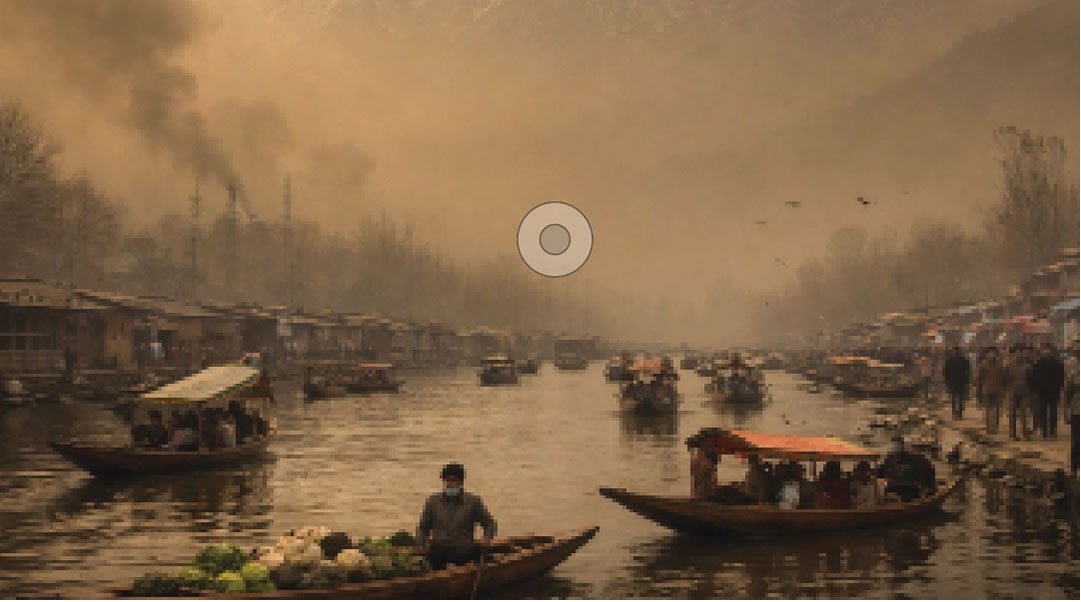
The deteriorating AQI in Kashmir is no longer just an environmental concern; it is a full-blown public health and economic crisis. The iconic view of the snow-clad mountains, now frequently obscured by a brown haze, serves as a daily, visible reminder of what is at stake.

Dr. Touseef Ahmad Bhat
Nestled amidst the majestic Himalayas, Kashmir has long been celebrated as “Paradise on Earth.” Its imagery is one of pristine snow-capped peaks, crystal-clear Dal Lake, and lush orchards. However, in recent years, a sinister veil has begun to descend upon this idyllic landscape – a veil of dense, toxic smog. The deteriorating Air Quality Index (AQI) in Kashmir, particularly in its capital, Srinagar, and other urban centres, is sounding an alarm for an environmental and public health emergency, challenging the very essence of the region’s identity.
From Pristine to Polluted:- Understanding the Shift
For decades, Kashmir’s air quality was considered among the best in India. Its high-altitude location and valley geography, however, have become a double-edged sword. During winter, the valley experiences a phenomenon known as temperature inversion. A layer of cold, dense air gets trapped near the ground, sealed by a layer of warmer air above, acting like a lid on a pot. This lid prevents the vertical dispersion of pollutants, causing them to accumulate to hazardous levels.
The primary drivers of this alarming decline in AQI are:
1. Transportation Boom:An exponential increase in the number of vehicles, including both personal cars and commercial transport, often running on fuel of dubious quality. Traffic congestion in Srinagar is a major contributor of particulate matter (PM2.5 and PM10) and nitrogen oxides.
2. Industrial and Generator Emissions:Unregulated small-scale industries, brick kilns operating with outdated technology, and the rampant use of diesel generators due to unreliable electricity, especially in winter, spew copious amounts of black carbon and sulphur dioxide.
3. Domestic Coal and Biomass Burning:As temperatures plummet, households, government offices, and businesses resort to heating through traditional bukharis (wood-burning stoves) and hamams (central heating systems) fuelled by cheap coal, wood, and even plastic waste. This is arguably the single largest source of winter smog, releasing high concentrations of PM2.5 and carcinogens.
4. Construction and Road Dust:Unchecked construction activity and poor road conditions generate massive amounts of dust, a significant component of PM10.
5. Geographical Trap: The Pir Panjal and Greater Himalayan ranges encircle the Kashmir Valley, preventing winds from effectively flushing out the accumulated pollution.
6. Agricultural Stubble Burning: While less pronounced than in Punjab, the practice of burning paddy residue in surrounding areas contributes to the seasonal pollution load.
The Hard Data: AQI in the Red Zone
Winter months, particularly from November to February, paint a grim picture. Srinagar consistently records AQI values in the “Very Poor” (301-400) and “Severe” (401-500) categories, often rivalling and sometimes surpassing notoriously polluted cities like Delhi. In January 2023, Srinagar’s AQI breached the 500 mark on several days, a level deemed hazardous for all life forms. Monitoring stations across the valley, including in Sopore, Baramulla, and Pulwama, have shown similar deteriorating trends, indicating a valley-wide crisis.
The Multifaceted Impact:- Beyond Hazy Skies
The consequences of this pollution are profound and far-reaching:
Public Health Catastrophe:-Hospitals report a 30-50% surge in respiratory illnesses during winter – chronic obstructive pulmonary disease (COPD), asthma, bronchitis, and lung infections. The ultrafine PM2.5 particles penetrate deep into the lungs and bloodstream, leading to increased cases of cardiovascular diseases, strokes, and cancers. The most vulnerable are children, the elderly, and those with pre-existing conditions.
• Economic Costs:The health crisis translates into massive economic burdens due to healthcare costs and lost productivity. Furthermore, the smog tarnishes Kashmir’s global image as a pristine tourist destination, potentially impacting its vital tourism industry.
• Environmental Damage: The deposition of black carbon on glaciers (like the Kolahoi and Thajiwas) accelerates their melting by reducing albedo (reflectivity), threatening long-term water security for millions. It also harms the region’s unique biodiversity, including its famous saffron fields and apple orchards, through acid deposition and reduced sunlight.
• Loss of Livelihood and Lifestyle:For communities dependent on outdoor work, from farmers to construction labourers, severe air days mean lost wages and health risks. The simple act of walking or exercising outdoors becomes a health hazard.
The Path to Clean Air: Challenges and Solutions
Addressing Kashmir’s air pollution is complex, intertwined with issues of energy security, economic development, and governance. However, a multi-pronged strategy is imperative:
1. Clean Heating Transition:This is the most critical intervention. Promoting and subsidising cleaner alternatives like electric heating (radiators, heat pumps), improved LPG distribution, and solar-powered heaters is essential. Phasing out the use of cheap, high-sulphur coal and banning the burning of plastic and waste must be enforced.
2. Transport Overhaul: Accelerating the shift to electric vehicles (EVs) with robust charging infrastructure, improving and electrifying public transport, enforcing stricter vehicle emission norms (BS-VI), and decongesting cities through ring roads and traffic management.
3. Industrial Regulations: Enforcing emission control technologies for brick kilns (e.g., Zig-zag technology) and small industries, and promoting cleaner fuels.
4. Dust Management: Enforcing mandatory covering of construction sites and transportation of debris, and water-sprinkling on roads.
5. Afforestation and Awareness: Aggressive greening drives and public awareness campaigns to educate citizens about the health impacts and alternatives to solid fuel burning.
6. Strengthening Monitoring: Expanding the real-time air quality monitoring network to more towns and making data publicly accessible to inform policy and public behaviour.
7. Policy and Enforcement: Formulating a Comprehensive Valley-Air-Shed Management Plan with strict enforcement mechanisms, inter-agency coordination, and dedicated funding.
The deteriorating AQI in Kashmir is no longer just an environmental concern; it is a full-blown public health and economic crisis. The iconic view of the snow-clad mountains, now frequently obscured by a brown haze, serves as a daily, visible reminder of what is at stake. The “Paradise on Earth” stands at a crossroads. The choices made today – between short-term convenience and long-term sustainability, between polluting fuels and clean energy – will determine whether Kashmir can reclaim its clear, life-giving air or succumb to a future where its beauty is only a memory, hidden behind a permanent, choking shroud. The time for action is now, before the valley’s air becomes as much a trap as its beautiful geography.
(The author is a prominent Kashmiri socio-environmentalist and activist focused on environmental conservation, sustainability, and community empowerment in Jammu & Kashmir. He is known for organising plantation drives, protesting air pollution, and advocating for green policies, often blending eco-friendly initiatives with social welfare.)