

Dr. Noor Ali Zehgeer
The shifting political landscape and the abrogation of Special Status have fundamentally transformed the socio-economic realities of Jammu & Kashmir. Decades ago, during the 1980s, students focused primarily on academic results because the playing field felt relatively level. Today, however, young aspirants must not only fight for every single mark but also scramble for the dwindling 30 to 35 percent of seats remaining in the open category. Securing admission to a reputable college or landing a government job has become an uphill battle, even for top performers. Life has grown increasingly challenging for job seekers across the region as political expediency continues to shape recruitment framework decisions. Yet, public policy must ultimately be judged not by its intentions, but by its tangible outcomes. Reservation policies were originally introduced across India to advance social justice, empower historically disadvantaged communities, and correct systemic inequalities, objectives that remain vital today. However, in Jammu & Kashmir, recent structural changes to the reservation framework have ignited widespread discontent, leading many young people to question whether the essential balance between merit and social justice has been broken.
For decades, Kashmiri families have viewed education as the most dependable path toward professional success and economic mobility. In a region where private-sector opportunities remain severely constrained and government service remains the primary employer, access to higher education and public jobs carries immense significance.
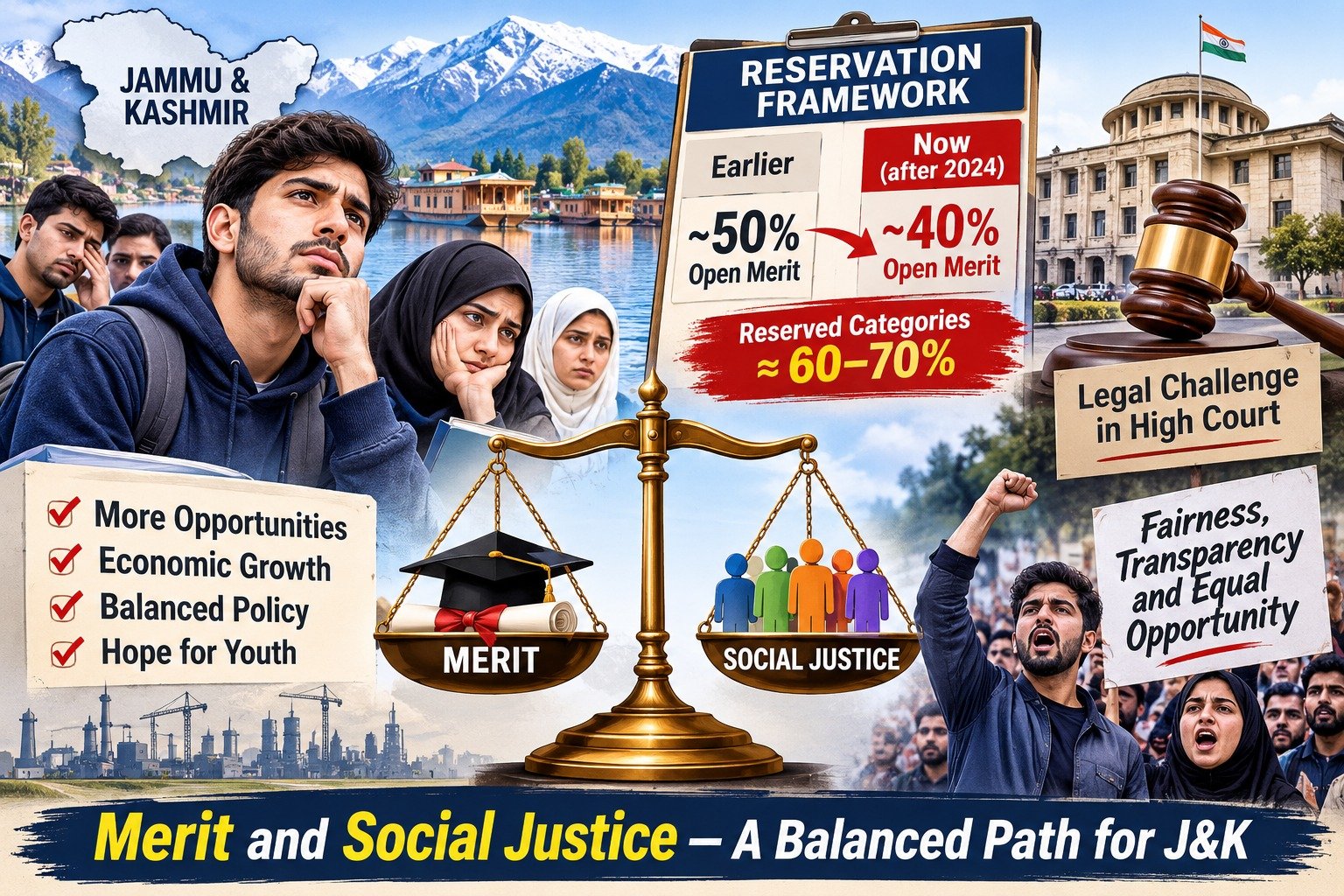
The controversy deepened following amendments to the reservation rules in March 2024, which expanded reservations for several categories, including Scheduled Tribes and Other Backward Classes. Published analyses indicate that the share of seats and posts allocated to the Open Merit category fell from approximately 50 percent to roughly 40 percent, while reserved categories grew to account for nearly 60 percent of government vacancies and educational seats. Critics further argue that when horizontal reservations are factored in, the total reserved quota approaches 70 percent in certain recruitment drives.
This policy shift has generated deep anxiety among students and job aspirants. According to the 2011 Census, nearly 69 percent of Jammu & Kashmir’s population falls within the general or open-category segment. These candidates now find themselves competing for a drastically reduced pool of opportunities.
The problem is further magnified by the region’s broader economic realities. Jammu & Kashmir has long suffered from some of the highest youth unemployment rates in India. Because government jobs are highly coveted, recruitment notifications for a few hundred vacancies frequently draw tens of thousands of applicants. In such an intensely competitive ecosystem, any reduction in open-merit positions inflicts immediate and severe hardship on young candidates striving to build a future.
Recent admission and recruitment figures have added fuel to the ongoing debate. Statistical reports examining medical college admissions and civil service recruitment show a marked drop in open-merit seats following the 2024 revisions. Cutoff scores for general category candidates have surged, forcing students to secure extraordinarily high marks simply to qualify for professional courses.
At the same time, advocates of the expanded reservation framework present a compelling counterargument. They maintain that affirmative action remains indispensable for upliftment and political inclusion. Proponents view the addition of new groups to the reserved categories—particularly among marginalized tribal populations—as a long-overdue measure to ensure equitable representation. For its part, the government maintains that these revisions aim to promote inclusion rather than disenfranchise any specific community.
This polarization has inevitably reached the judicial system. Multiple petitions challenging the revised reservation rules are currently before the High Court of Jammu & Kashmir and Ladakh. Petitioners argue that the current quota structure unconstitutionally squeezes open-merit candidates, while defenders frame it as a crucial instrument of social justice. The ongoing legal battle seriousness the depth of public frustration.
This ongoing debate does not need to be a zero-sum choice between merit and social justice; a progressive society demands both. Merit encourages excellence, innovation, and trust in public institutions, while social justice ensures that historically disadvantaged communities are not excluded from progress. The central challenge lies in crafting a policy that commands broad public confidence. Jammu & Kashmir would benefit significantly from a comprehensive, evidence-based review of its reservation framework—one informed by rigorous demographic data, socio-economic indicators, educational statistics, and long-term employment trends. Policies shaping the destiny of an entire generation must be systematically evaluated to ensure they fulfill their intended purpose without eroding public trust.
Equally critical is the need to expand the overall economic footprint of the region. Debates over quotas become fiercest when opportunities are scarce. Substantial investment, industrial expansion, entrepreneurship, technology-driven sectors, and private-sector growth are urgently needed to reduce the overwhelming reliance on government jobs. Yet, a fundamental question remains: do regional policymakers possess the vision and political will to prioritize these economic structural changes?
The youth of Kashmir and their parents are not asking for unearned privilege. They are asking for fairness, transparency, and a system where individual effort and academic achievement still matter. Their grievances deserve meaningful engagement rather than political polarization.
As Jammu & Kashmir moves forward, policymakers must forge a framework that protects vulnerable communities while preserving hope for every aspirant. Lasting social cohesion will not spring from competing claims of entitlement, but from a balanced ecosystem that harmonizes equity, merit, and opportunity for all.