

Dr Umer Iqbal
In Jammu and Kashmir, where the public sector and state-backed financial bodies remain the sole economic lifeline for hundreds of thousands of educated youths, employment announcements rarely pass as routine administrative exercises. They are seismic events, capable of igniting hope or triggering widespread distress. When Jammu & Kashmir Bank Ltd. released its latest recruitment notification inviting applications for nearly 1,400 vacancies, comprising Probationary Officers (POs) and Banking Associates, the initial wave of expectation quickly dissolved into widespread anger, systemic disillusionment, and fierce political debate across the Union Territory.
At the epicentre of the growing storm is a double-barrelled grievance that has brought thousands of job seekers onto the internet and filled digital corridors with bitter protest: a drastic age cutoff that locks out a generation of aspirants, and a newly implemented reservation matrix that squeezes the unreserved pool down to a minority fraction. For Open Merit candidates, who represent a vast majority of the applicant population, the notification feels less like a competition and more like an institutional exclusion zone.
THE AGE BARRIER: UNPARDONABLE TIME LOSS AND THE DEMAND FOR A 40-YEAR UPPER LIMIT
The most immediate wall confronting job aspirants in Jammu and Kashmir is the rigid age criterion prescribed by the bank. For both Probationary Officers and Banking Associates, J&K Bank has set the minimum age at 20 years and capped the maximum age at 30 years as of January 1, 2026. For Probationary Officer positions, this marks a strict retreat from previous selection cycles, where the upper limit stood at 32 years.
To understand why a 30-year cap has generated such fierce hostility, one must examine the operational reality of public recruitment in Jammu and Kashmir. Large-scale recruitment drives do not happen on a predictable annual calendar. The current hiring initiative comes after a long, agonising gap of nearly six years. For thousands of young men and women who graduated in their early twenties, the years between notifications vanished without a single opportunity to sit for an examination.
Now, upon the arrival of a fresh notification, aspirants discover that the clock ran out while they were forced to wait. A candidate who was 30 years old when the previous major hiring cycle wrapped up is now 37, rendered ineligible by the passage of time without ever having flinched from their preparation.
Aspirants and youth organisations, led prominently by the Jammu and Kashmir Students Association (JKSA), argue that placing the burden of institutional lulls onto job seekers is an egregious injustice. The association, alongside several cross-party political leaders, has formally petitioned Lieutenant Governor Manoj Sinha, seeking immediate executive intervention to harmonise J&K Bank’s eligibility framework with that of the Union Territory’s primary government recruitment agency-the Jammu and Kashmir Services Selection Board (JKSSB).
Under standard JKSSB regulations for UT government posts, Open Merit candidates are granted an upper age limit of up to 40 years. Student bodies question why J&K Bank, despite being the largest institutional employer in the UT outside the government proper, operates under restrictive age brackets that disqualify an entire cohort of youth who lost their prime competitive years through no fault of their own.
“When examinations are conducted after a gap of five or six years, an age cap of 30 years effectively ensures that a student gets only one or two chances in their entire youth to sit for a bank exam,” lamented one open merit applicant in Srinagar. “If JKSSB can offer an upper limit of 40 years to compensate for systemic delays, why is J&K Bank punishing us for its own extended delays?”
THE RESERVATION MATHEMATICS: THE SHRINKS OF OPEN MERIT TO 40 PERCENT
While the age limit restricts who can walk through the door, the bank’s updated reservation matrix determines how narrow the passage is once inside. The new recruitment notification incorporates the provisions of Executive Order S.O. 176, issued by the Social Welfare Department of J&K on March 15, 2024, altering the distribution of seats across categories.
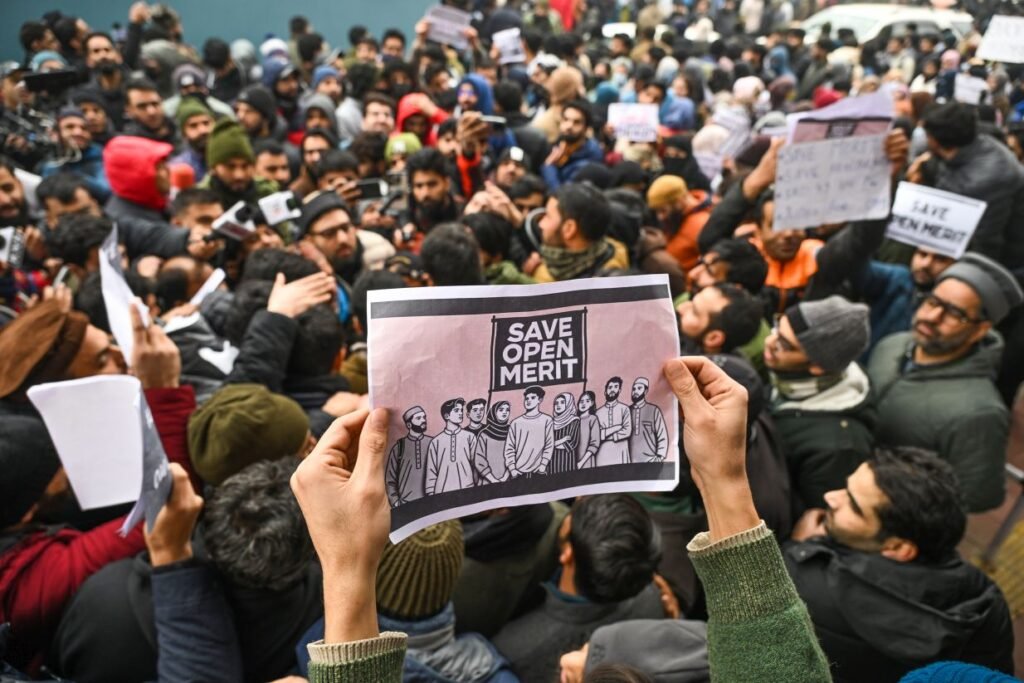
Out of the total notified vacancies, 60 percent of all posts are reserved for specific socio-economic and regional categories, leaving a slim 40 percent allocation for Open Merit candidates.
J&K BANK RECRUITMENT 2026: RESERVATION BREAKDOWN
| Category | Quota Share (%) |
| Open Merit (General Pool) | 40% |
| Scheduled Tribes (ST – Combined Existing & New) | 20% |
| Resident of Backward Areas (RBA) | 10% |
| Economically Weaker Sections (EWS) | 10% |
| Scheduled Castes (SC) | 8% |
| Other Backward Classes (OBC) | 8% |
| Actual Line of Control / International Border (ALC/IB) | 4% |
| TOTAL QUOTA RESERVED: | 60% | OPEN MERIT: 40% |
Horizontal Reservations: Persons with Benchmark Disabilities (PwBD) – 4% Ex-Servicemen (Banking Associates) – 6%
Under this layout, the 20 percent reservation for Scheduled Tribes is divided equally: 10 percent for historically listed ST communities (such as Gujjars, Bakarwals, Baltis, and Gaddis) and 10 percent for newly incorporated tribal groups, including the Pahari Ethnic Group, Paddari Tribe, Gadda Brahmin, and Koli communities. Residents of Backward Areas (RBA) and Economically Weaker Sections (EWS) each hold a 10 percent slice. Scheduled Castes (SC) and Other Backward Classes (OBC) are allocated 8 percent each, while residents along the Line of Actual Control (ALC) and International Border (IB) receive 4 percent.
Furthermore, 4 percent horizontal reservation is carved out across categories for Persons with Benchmark Disabilities (PwBD), alongside a 6 percent horizontal quota for Ex-Servicemen in Banking Associate cadre roles.
For Open Merit candidates, who comprise a massive percentage of the applicant pool, this breakdown represents a mathematical wall. In absolute numbers, out of 1,033 Banking Associate posts allocated for the Union Territory of J&K, fewer than 415 seats remain open for general competition. For the Probationary Officer cadre, where only 323 vacancies were announced for J&K, the general pool shrinks to approximately 129 seats.
The Open Merit student community points out that “Open Merit” is not a reserved category for unreserved castes; it is the open arena in which candidates from reserved categories can also compete if their scores exceed the general cutoff. Consequently, reserving 60 percent of seats at the outset means that general category candidates, regardless of their academic achievements, are restricted to competing within a minor 40 percent share of the total pie.
Student representatives argue that while affirmative action is a recognised tool for social justice, its expansion without a proportional increase in overall job creation has turned recruitment into a zero-sum game. Open Merit students, many of whom come from financially fragile families that do not fall under official EWS parameters, feel increasingly alienated by an administrative framework that leaves them minimal room to secure employment based purely on academic merit.
HISTORICAL SHADOWS: THE CHHIBBER ERA, VHP TRUSTEESHIP, AND REGIONAL DISTRUST
To understand why the current recruitment crisis carries such emotional and political force, one must trace the institutional history of J&K Bank over the past decade. As the premier financial entity of the state, the bank was historically viewed not only as a lender but as a key economic pillar of regional autonomy and local employment. However, its recruitment processes have repeatedly been shadowed by governance controversies, shifting political dynamics, and persistent allegations of regional bias.
A critical turning point occurred during the tenure of R.K. Chhibber, who was appointed Chairman and Managing Director of J&K Bank in June 2019 following the abrupt removal of Parvez Ahmed. Chhibber’s leadership coincided with the constitutional restructuring of Jammu and Kashmir into a Union Territory, a period marked by rapid policy overhauls across state institutions.
During Chhibber’s tenure, the bank conducted a major recruitment drive for 1,500 Banking Associates between 2021 and 2022, attracting nearly 1.40 lakh local applicants. That drive, however, became mired in fierce controversy when selection lists were published. Aspirants from the Kashmir division raised loud allegations of regional imbalance, asserting that final selection lists heavily favoured candidates from the Jammu division at the expense of Kashmiri candidates with comparable or superior credentials. The perception of regional bias severely damaged institutional trust in the bank’s selection mechanisms.
The controversy deepened as details regarding Chhibber’s administrative roll and affiliations surfaced. Even after stepping down from executive leadership, Chhibber continued to serve on the Bank’s Board of Directors until 2026. During this same timeframe, he was appointed as a trustee of the Vishva Hindu Parishad (VHP), a prominent religious-political organisation.
The dual identity of an influential long-serving board member who simultaneously held a high-profile trusteeship in an ideological organisation became a lightning rod for public critique. Critics and student bodies pointed out that Chhibber had been a primary proponent for altering J&K Bank’s recruitment framework and aligning its policy with sweeping government reservation quotas.
For many in the Kashmir valley and among Open Merit advocates, the legacy of that era created a lasting impression: that institutional recruitment was being redesigned not merely for administrative modernization, but to engineer demographic and regional shifts within the bank’s workforce. That lingering distrust continues to colour the reaction to the 2026 notifications. When aspirants see a 60-40 reservation ratio combined with a tight 30-year age cap, they view it through the prism of these recent historical grievances.
POLITICAL CONVERGENCE: ACROSS THE DIVIDE, A RARE CONSENSUS
The anger brewing on university campuses in Srinagar, Jammu, Anantnag, and Jammu’s university belts has spilled into the political arena, creating a rare point of consensus among otherwise fiercely opposed political factions.
Leaders across the political spectrum have issued sharp statements condemning the bank’s current recruitment terms and demanding immediate corrective action:
Waheed Ur Rehman Parra (PDP MLA): Parra was among the first to formally challenge the notification, emphasizing that J&K Bank cannot operate in a vacuum detached from the social realities of the Union Territory. He noted that when government bodies like JKSSB acknowledge the structural delays in J&K by providing a 40-year upper age limit, the bank’s decision to drop PO and BA posts age limits down to 30 years is institutional negligence. Parra called for an immediate age relaxation and a complete re-examination of the reservation layout to safeguard the rights of Open Merit students.
Mohammad Yousuf Tarigami (CPI-M Leader/MLA):Tarigami highlighted the double jeopardy faced by youth, who suffer both from an absence of private sector industrial jobs and from artificial barriers in public sector hiring. He urged the UT administration and J&K Bank board to immediately adopt JKSSB age norms, warning that closing doors on educated youth who spent years preparing during exam freezes would deepen the psychological alienation of the region’s young population.
Muntazir Mehdi (PDP MLA): Focus on the timing of the examination, Mehdi pointed out that conducting exams after nearly six years without offering age relaxation violates basic principles of administrative equity. He reiterated that the bank previously allowed candidate eligibility up to 32 years for PO positions, making the reduction to 30 years during a recruitment drought completely unviable.
Across the board, regional politicians are united in their demand: J&K Bank must act as a benevolent, public-facing institution rather than a rigid corporate body that ignores local socioeconomic realities.
THE COST OF SLOW REFORMS: BRAIN DRAIN AND YOUTH DESPAIR
Beyond the technicalities of reservation percentages and age relaxations lies a human crisis unfolding across households in Jammu and Kashmir. For years, securing a post as a Banking Associate or Probationary Officer in J&K Bank was viewed as a gold-standard career path, offering financial security, respectable pay scales and the ability to serve within one’s home state.
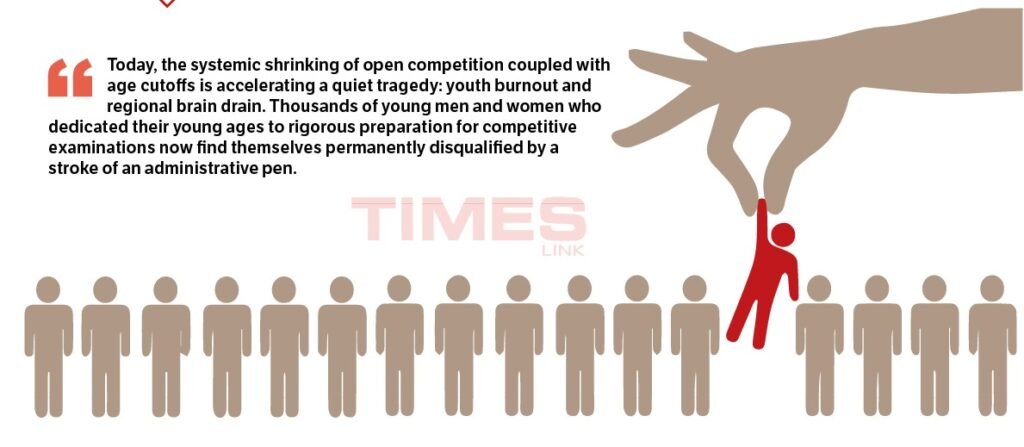
Today, the systemic shrinking of open competition coupled with age cutoffs is accelerating a quiet tragedy: youth burnout and regional brain drain. Thousands of young men and women who dedicated their young ages to rigorous preparation for competitive examinations now find themselves permanently disqualified by a stroke of an administrative pen.
“You study ten hours a day for five years, waiting for a single advertisement,” says a 38-year-old postgraduate candidate from Baramulla who is now ineligible to apply. “When the ad finally comes, you aren’t disqualified because you failed an exam; you are disqualified because the bank took six years to issue the notice, and because the open pool has shrunk to a fraction. Where are we supposed to go? What private industry exists in Kashmir or Jammu to absorb us?”
THE WAY FORWARD: RECONCILING MERIT, EQUITY, AND ACCESS
As the deadline for online registration approaches on November 26, 2026, pressure is building on the J&K Bank Board of Directors and Lieutenant Governor Manoj Sinha to step in before the examination process proceeds further under the disputed framework.
Legal experts, administrative analysts, and student advocacy groups argue that a fair resolution requires three immediate steps:
1. Immediate Adoption of JKSSB Age Guidelines: J&K Bank should grant a one-time age relaxation extending the upper age limit for Open Merit candidates to 40 years. This would directly address the lost six-year gap between recruitment notifications and place bank applicants on an equal footing with state government aspirants.
2. Rationalization of the Reservation Matrix: While adhering to statutory requirements under S.O. 176, the administration must evaluate ways to expand the total volume of advertised posts or create supplementary recruitment tracks. Ensuring that merit-based recruitment remains robust is essential for maintaining institutional quality within the bank while respecting social justice mandates.
3. Restoration of Institutional Transparency: To overcome the historical baggage of the 2021–2022 recruitment cycle and the legacy of regional imbalance allegations, J&K Bank must ensure absolute transparency in score disclosures, cut-off metrics, and candidate shortlisting across both Jammu and Kashmir divisions.
The growing controversy surrounding J&K Bank’s 2026 recruitment drive is more than a dispute over an exam notification; it is a test of how institutions in Jammu and Kashmir treat their youth. In a region working to build stability and economic resilience, shutting out an entire generation through administrative rigidity and reduced open competition is a recipe for deepened despair. As public outcry grows, all eyes remain on the bank management and UT leadership to see whether they will listen to the voices of tens of thousands of aspirants demanding nothing more than a fair, inclusive, and level playing field.
>>>>>>>>>>>>>
Box
Health Minister Sakina Itoo seeks 40-year upper limit
Providing a shot in the arm of growing demands from job aspirants, Jammu and Kashmir Health and Medical Education Minister Sakina Itoo supported the demand for age relaxation in Jammu and Kashmir Bank recruitment. She urged the bank authorities to raise the upper age limit to 40 years to provide a fair opportunity to aspirants who have lost valuable years waiting for recruitment.
In a post on X, Sakina said thousands of aspirants had spent years waiting for recruitment opportunities and should not be penalised for delays beyond their control.
“Dreams shouldn’t have an expiry date! Thousands of J&K Bank aspirants have lost precious years waiting for recruitment opportunities. They must not be punished for delays beyond their control,” she said.
Appealing to the bank authorities, minister Itoo said the upper age limit should be extended to 40 years to ensure that eligible candidates get an opportunity to compete.
“Give our youth a fair chance. Their future cannot wait,” she added.