

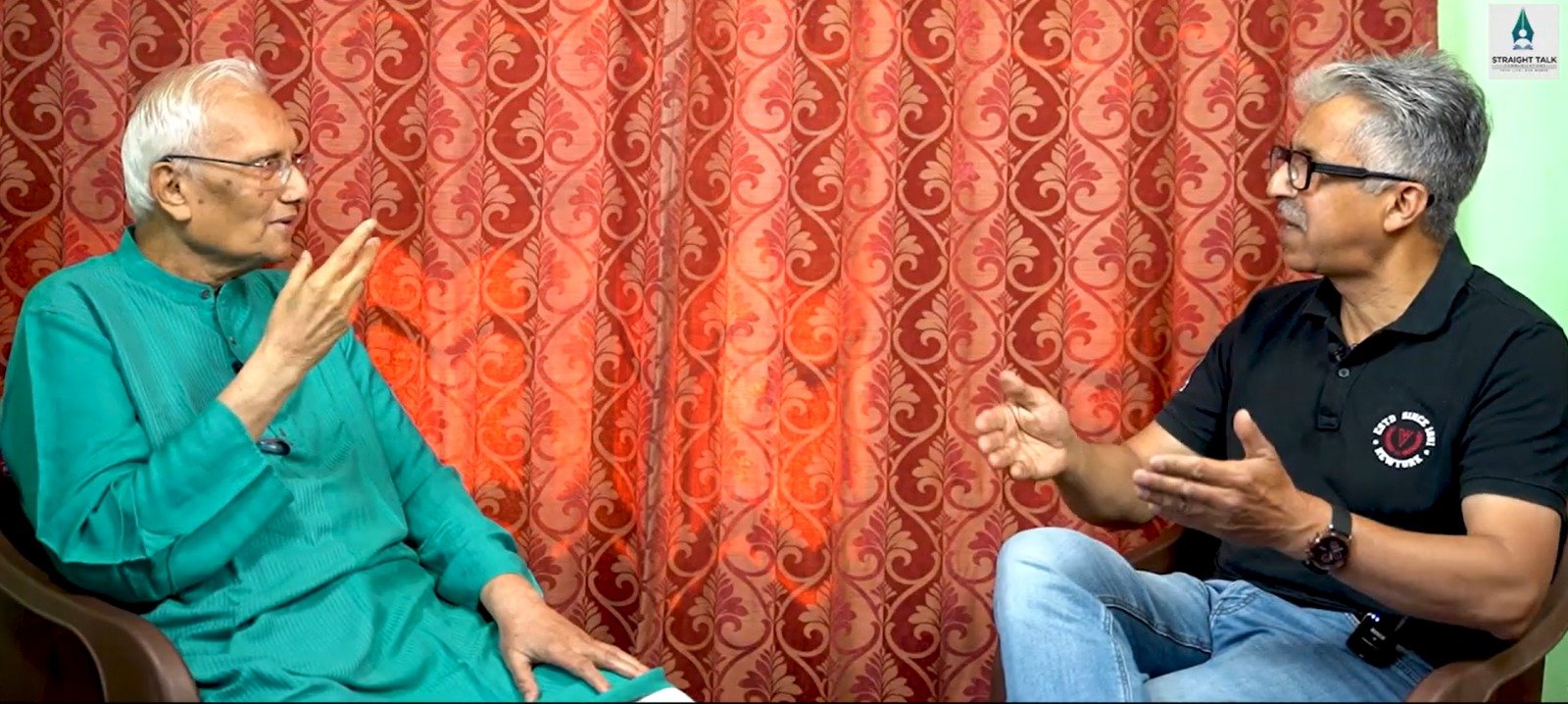
Everyone understands the profound dividends of peace. If India-Pakistan relations normalise, societies on both sides of the border will reap immense economic, social, and political benefits. While diverse opinions exist on various historical matters, the consensus that statehood should be reinstated to the people of Jammu and Kashmir is broad and unequivocal. We would be immensely gratified if news of the restoration of statehood were announced by the Government of India today, said Om Prakash Shah, the Chairman of the Center for Peace and Progress, in a Straight Talk Session with SAJJAD BAZAZ,
TIMES LINK EDITOR. Known as a tireless champion of peace, Shah talks about
his experience in driving Track-II diplomacy to garner peace in Kashmir.
EXCERPTS OF THE CONVERSATION
SAJJAD BAZAZ: Let us begin straightway with your organisation, the Center for Peace and Progress, which has been at the forefront of peace initiatives for decades. Could you tell us about its genesis and core mission?
O. P. SHAH: The Center for Peace and Progress is a registered trust. Through this platform, we engage with critical national and international affairs, organising seminars, discussions, and conferences across the country to build consensus on vital issues.
Over the years, the Center has worked extensively to bridge the divide between India and Pakistan and address the situation in Jammu and Kashmir. In fact, over the past few years, we have published two comprehensive volumes titled ‘In Pursuit of Peace: Improving Indo-Pak Relations’, alongside regular roundtable discussions. Until visa restrictions tightened, we frequently facilitated cross-border delegations – bringing Pakistani intellectuals, activists, and diplomats to India while leading Indian delegations across the border to Lahore, Islamabad, and Peshawar.
Even when physical travel became restricted, we pivoted to virtual platforms, hosting monthly meetings without interruption. Our core belief is simple: dialogue is the essence of democracy. We strive to bring diverse voices from both India and Pakistan into conversation to heal what is essentially a profound crisis of confidence and trust deficit. To overcome this deficit, sustained dialogues, seminars, and publications are both useful and utterly indispensable.
From Corporate Boardrooms to Track-II Diplomacy
SAJJAD BAZAZ: Before delving deeper into your peace initiatives, I would like to touch upon your professional background. You started your career as a chartered accountant and management consultant. How did this fascinating transition to track-II diplomacy happen?
O. P. SHAH: I was – and still am – a chartered accountant and management consultant. I have taught at institutions like St. Xavier’s College in Calcutta. I also edited a journal called Parlance starting back in 1977, and served a term as a member of the Press Council of India from 1982 to 1985.
How did I enter what you call track-II diplomacy? Imagine the situation in Kashmir back in 1991 – it was extraordinarily volatile. It was during that period that I met I. A. Rehman, the legendary Pakistani human rights activist, writer, and intellectual who, sadly, is no longer with us. We met at the India International Center in New Delhi, where we both happened to be staying at the time. We resolved to initiate a structured people-to-people dialogue.
Our very first dialogue was held in New Delhi, featuring a 13-to-14-member delegation from Pakistan. Following that, I led two delegations to Pakistan—first in December 1991, with meetings across Lahore, Islamabad, and Peshawar, and subsequently in April 1992, for what we termed the Indo-Pak Dialogue-II in Islamabad. That delegation included notable figures such as Inder Kumar Gujral, Kuldip Nayar, Ram Jethmalani, and Gauri Gill, with myself coordinating and leading the effort. We spent three and a half days in Pakistan, holding extensive sessions following an inaugural conference. That marked the beginning, and the journey has continued ever since.

Evaluating the Transformation in Kashmir (1991–2019)
SAJJAD BAZAZ: Looking back across this expansive journey from 1991 up to the abrogation of Article 370 in 2019, how do you view the transformation in Jammu and Kashmir?
O.P. SHAH: The situation in 1991 was profoundly harrowing – deeply volatile, marked by widespread violence, daily killings, and countless individuals held in jails or interrogation centres. When I first visited, the atmosphere felt surreal. Cities would virtually shut down by 5:00 PM, and frequent hartals(shutdowns) were the norm.
By contrast, the situation in 2019—while certainly not perfect or fully restored to normalcy—exhibited a substantial and significant improvement. Physical violence had drastically receded; stone-pelting, civilian casualties, and crippling shutdowns had largely ended. The ground reality is totally different from 1991.
However, significant deficiencies remain. For instance, statehood has not yet been restored, and that must happen. Every aspect of a robust democratic setup needs to function properly here. The freedom of the press that exists in Patna, Lucknow, or Delhi must be equally protected and nurtured in Jammu and Kashmir. While complaints occasionally arise, the overarching environment has shifted away from open physical violence.
SAJJAD BAZAZ: Have you raised these democratic deficits—such as the pending restoration of statehood and press freedom—with higher authorities at the Prime Minister’s Office or the Home Ministry? Have you run campaigns or organised seminars to advocate for these changes?
O. P. SHAH: We have made extensive efforts. Numerous formal representations and letters have been addressed to the Prime Minister and the Home Minister. We have organised conferences and seminars in Delhi, Calcutta, Jammu, and twice attempted to hold them in Srinagar, though logistical and administrative hurdles prevented those local events from taking place.
As an independent non-governmental organisation, we do not operate under government control. We have held numerous meetings regarding both Kashmir and Indo-Pak relations, and these insights have been conveyed to the authorities.
SAJJAD BAZAZ: And what has been the response from the government?
O. P. SHAH: The government has never provided us—or indeed anyone else in civil society—with written responses. It appears to be a policy of the current administration not to engage directly in point-by-point public correspondence.
Nevertheless, through the Center for Peace and Progress and our civil society partners across various cities, our endeavour has been to bring these critical issues to light. The media has frequently cooperated; our meetings in Jammu received robust coverage, and our gatherings across the country and in Srinagar enjoyed reasonably good media attention. While the government has not accepted all our recommendations—statehood, for instance, remains unfulfilled, and the press requires greater freedom through direct consultation with local media representatives—we believe consultation is the bedrock of democracy. Policies should be shaped through dialogue and interaction, not unilateral decree.
Inside the Conflict: Encounters with Separatists, Mainstream Leaders, and Common Citizens
SAJJAD BAZAZ: You have been visiting Kashmir for the past 35 years, often staying for weeks or months at a time – logging well over a thousand nights here. Your interactions have spanned across the entire spectrum: common citizens, mainstream leaders, and even hardcore separatist cadres. Could you share some of your experiences?
O. P. SHAH: A general truth emerged from almost all my interactions: everyone desired peace, harmony, and normalcy. Remarkably, I never met a single separatist leader—leaving aside mainstream politicians for a moment—who actively advocated for violence. When violence occurred, they expressed deep concern and sorrow. They were fundamentally dissatisfied with violent methods.
I say this with absolute honesty and responsibility: the common Kashmiri, whether a political figure or an ordinary citizen, did not believe in or champion violence.
I recall entering the Central Jail in Srinagar at 8:00 AM and remaining there until 7:00 PM, conversing with detainees across various barracks. On one particular day, dozens of inmates approached me voluntarily. Without me asking, they handed me handwritten notes, looking to me as a source of hope or rescue. Visiting them was a profound gesture that surprised and deeply touched them.
In those barracks, I shared endless cups of tea—easily drinking 30 to 40 cups across different cubicles as inmates insisted I sit with them and converse. Many told me, “We never wanted violence; circumstances swept us into this vortex.” Some explained that they had been wrongly caught up in the turmoil, while others expressed regret over the breakdown of civil order.
SAJJAD BAZAZ: That perspective is striking, especially given that figures like Syed Ali Shah Geelani and the Hurriyat leadership were seen as spearheading the agitation. How do you reconcile their stated positions with the reality of the protests?
O. P. SHAH: As I noted, while they pursued a specific political objective, did they fundamentally believe in violence as an end in itself? I could never say that. Whenever I spoke with Mr. Geelani, he never justified violence. In fact, he would often argue, “How can we afford violence? What power do we possess against the might of the state? Why would we encourage it?”
While what they communicated to their followers in public rallies is a matter for public record, in my direct, personal conversations with Mr. Geelani, he was never in favour of violence. In fact, he maintained the traditional warmth and courtesy of an elder. I often felt a sense of embarrassment—especially when visiting him at his home in Malviya Nagar, Delhi, during the winter months when he stayed with minimal staff. Despite being much older than me, he would personally prepare and bring tea and breakfast to our meetings, which his wife had prepared.

Kashmir: A Dispute or an Issue?
SAJJAD BAZAZ: Looking at the roots of this conflict, you mentioned in a previous conversation that “Kashmir is not a dispute; it is an issue.” Could you elaborate on what you mean by that distinction?
O. P. SHAH: Dialogue is the only civilised mechanism through which human society resolves complex challenges. Kashmir is certainly an issue—there is no doubt about that. But its solution does not lie in violence, which only compounds complexity.
My good friend and former Pakistani Foreign Minister, Khurshid Mahmud Kasuri, often remarks during our interactions: “Look at how many wars we have fought. Did India gain an extra four inches of land? Did Pakistan? Neither nation gained anything meaningful from war.”Everyone understands the profound dividends of peace. If India-Pakistan relations normalise, societies on both sides of the border will reap immense economic, social, and political benefits.
SAJJAD BAZAZ: That conversation with Mr. Kasuri – was that recent?
O. P. SHAH: We recently participated in a virtual Zoom meeting on June 6th, and he has reiterated this sentiment in numerous physical conferences over the years. I firmly advocate for the immediate resumption of Indo-Pak dialogue.
SAJJAD BAZAZ: Should Kashmiris be an integral part of that dialogue?
O. P. SHAH: Absolutely. Since both nations claim Kashmir as an integral part of their identity, the framework must ensure that Kashmiris—who are directly affected—are consulted and represented whenever bilateral dialogues occur. When normal relations are established between India and Pakistan, cross-border mobility, commerce, and cultural exchange will naturally flourish. As I once told Mr. Kasuri, my ultimate aspiration is that before our time on earth is through, we will moderate a peace seminar together in Srinagar.
Resilience in the Face of Adversity and the Imperative of Unbroken Dialogue
SAJJAD BAZAZ: Whenever efforts have been made to thaw Indo-Pak relations—such as ahead of peace initiatives or high-level talks—tragic incidents like the recent militant attacks in Pahalgam occur, derailing the peace process. How do you view this recurring pattern? Which forces are hell-bent on ensuring relations never normalise?
O. P. SHAH: It is deeply unfortunate when such incidents occur. However, the hallmark of true leadership is persistence: in spite of such incidents, the conversation must never stop. If we allow our resolve to crumble because of acts of terror, we hand victory to the spoilers. Dialogue must continue with even greater seriousness.
When I was in Srinagar last year during Operation Sindoor, my family called every half hour urging me to return. Yet, across-the-border interlocutors and local friends alike agreed on one vital point: dialogue must not become hostage to terror attacks. War is never an option; history has proven that armed conflict inflicts mutual devastation without resolving underlying disputes.
Even in our ancient traditions—consider the epics of Ramayana, where armies stood arrayed in battle at Lanka—Lord Ram dispatched Angad on a final diplomatic mission precisely to avert wholesale carnage. Our civilisational ethos dictates that dialogue must endure through every vicissitude.
SAJJAD BAZAZ: We also witnessed active backend roles played by regional actors during Operation Sandoor—notably China and Bangladesh. When we look at the Center for Peace and Progress, is there an appetite to expand your focus to India-Bangladesh relations as well?
O. P. SHAH: Many friends have indeed urged us to turn our attention toward fostering civil society dialogue between India and Bangladesh, replicating the framework we utilized for Indo-Pak peace efforts. God willing, we will initiate work in that direction soon.
Highs and Lows of a 35-Year Journey
SAJJAD BAZAZ: Looking back over these 35 years in Kashmir, what moment caused you the deepest sorrow, and conversely, what moment brought you the greatest joy?
O. P. SHAH: I cannot point to one single isolated incident, but generally, whenever channels of dialogue were suspended, as an activist, I felt profound sorrow. Dialogue is the lifeblood of a civilised society. Conversely, the moments that gave me hope were the countless interactions inside jails and seminar halls where individuals—regardless of their past political affiliations—expressed an overwhelming fatigue with violence and an eager yearning for a peaceful, negotiated future.
Regarding governmental responses, prior administrations—whether led by P.V. Narasimha Rao, Atal Bihari Vajpayee, or Dr. Manmohan Singh—demonstrated an unwavering institutional faith in non-violence and sustained dialogue. While the current central administration under Prime Minister Narendra Modi has not engaged with us in the same consultative manner, our civil society memoranda and appeals continue to be placed on record.
Concluding Thoughts on the Contemporary Landscape
SAJJAD BAZAZ: To conclude our conversation, sir, how do you view the contemporary landscape of India vis-à-vis Jammu and Kashmir today?
O. P. SHAH: India is a vast nation confronting multifaceted challenges, and Jammu and Kashmir is certainly one of them. Yet, civil society across India remains deeply invested in the well-being and democratic normalisation of this region.
Whether in closed-door discussions or public seminars across the country, an overwhelming near-unanimity exists on one key imperative: the restoration of statehood without further delay. While diverse opinions exist on various historical matters, the consensus that statehood should be reinstated to the people of Jammu and Kashmir is broad and unequivocal.

We would be immensely gratified if news of the restoration of statehood were announced by the Government of India today.