

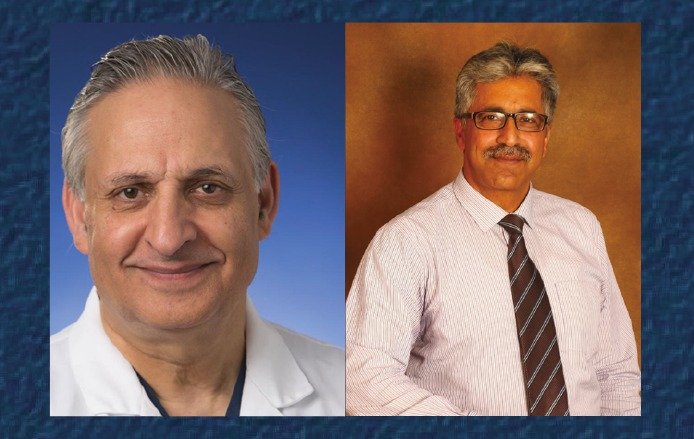
Dr. Fayaz Shawl responded to TIMES LINK questionnaire. Here are the excerpts of his conversation with its Editor, recorded electronically from Washington, D.C.
SAJJAD BAZAZ: Looking back at your journey from Kashmir to becoming a renowned cardiologist in the United States, what defining moments stand out the most?
DR FAYAZ SHAWL: Several moments stand out. Losing my father to stomach cancer when I was just 13 was the turning point that redirected my life toward medicine. Arriving in England in 1974 with barely $50 in my pocket was a defining test of courage. Performing the first angioplasty in the entire U.S. Military at Walter Reed Army Medical Center, Washington DC in 1981 was a professional milestone I am deeply proud of. But perhaps the most quietly powerful moment was inventing the Shawl Technique in 1988 — a percutaneous bypass support method that has meant not a single patient has died in my Cath lab during a coronary intervention sinceits introduction. Each of these moments shaped who I am.
SAJJAD BAZAZ: Moving from Kashmir to the United States is a major transition — what werethe emotional and professional challenges you faced initially?
DR FAYAZ SHAWL: The transition was humbling in every sense. I had already completed my residency in England, yet arriving in America meant starting completely from scratch — beginning with an internship in 1977 as though I were a fresh graduate. Financially, I had almost nothing.Emotionally, I carried the weight of a family back home that had depended on me since my father’s passing. Professionally, I faced skepticism — when I started the angioplasty program at Walter Reed, I encountered significant opposition from surgical colleagues who doubted its feasibility. Navigating all of that simultaneously required extraordinary resilience.
SAJJAD BAZAZ: What kept you motivated during the most difficult phases of your journey?
DR FAYAZ SHAWL: My father’s early death was my greatest motivator. Watching him pass away without adequate medical care when I was just a boy planted a fire in me that never went out. Beyond that, every difficult patient — every person who came to me with no options left —reminded me why I chose this path. I also drew strength from the mentors who believed in me, particularly Dr. David Goldman in the U.S., who recognized my potential and advanced my training by three years when I came from England in 1977. Their confidence in memade me refuse to give up.
SAJJAD BAZAZ: Can you share a particularly memorable case that left a lasting impact onyou?
DR FAYAZ SHAWL: Every patient who survives a procedure that was considered impossible stays with me. But I am deeply moved by a letter from one of my patients, Judge Leonard Ruben, who wrote tome saying: “You are a living embodiment of the meaning of the Hippocratic Oath… Yourhands are golden, your mind that of a genius and your heart larger than the world itself.”
That kind of human connection — knowing that your work gave someone more years withtheir children — is something no award can replicate.
SAJJAD BAZAZ:What has been the most rewarding aspect of your career so far?
DR FAYAZ SHAWL: Without question, it is teaching. I have trained physicians across the world — in the UnitedStates, India, Pakistan, and Bangladesh and beyond. Knowing that a cardiologist in SouthAsia today is saving lives usingtechniques I helped introduce to that region — that multiplies my impact in ways I could never achieve alone. The collaboration I embarked onto bring interventional cardiology to South Asia from 1989 onwards remains among my proudest contributions.
SAJJAD BAZAZ: How do you handle the emotional weight that comes with life and death decisions?
DR FAYAZ SHAWL: You never fully detach from it, nor should you. What I have learned over decades is to channel that emotional weight into precision and preparation. The Shawl Technique it self was born from my refusal to accept that high-risk patients who may to die on the table. Every innovation I pursued was driven by the question: what more can I do for this patient? Faith also grounds me. I carry a deep sense that I am an instrument in something larger than myself.
SAJJAD BAZAZ: Having experienced healthcare systems in both India and the United States, what key differences stand out to you?
DR FAYAZ SHAWL: The most striking difference is access. In the United States, infrastructure, technology, and institutional support allow a cardiologist to focus purely on the science of saving lives. WhenI served as an Assistant Surgeon in Shahdara Sharif, Rajouri early in my career, I was the sole doctor for over 6,000 patients — reached only first by a plane to Jammu, a ten-hour bus ride to Rajouri and then a horse to Shahdara Sharif. That level of isolation and resource scarcity is something American medicine has never faced. The commitment and sacrifice of doctors in Kashmir and South Asia is immense, but they deserve far better tools and systems to work with.
SAJJAD BAZAZ: Do you see potential for collaboration between global medical communities and Kashmir?
DR FAYAZ SHAWL: Absolutely, and it is something I have personally pursued through out my career. I brought coronary stents, catheters, and supplies worth thousands of dollars and donated them to SKIMS in Kashmir during my visits. I have lectured and conducted live teaching works hopsacross South Asia. The knowledge exists globally — what is needed is the political will,institutional cooperation, and sustained investment to bridge that gap. Kashmir has brilliant minds. With the right platforms, they can be world-class.
SAJJAD BAZAZ: Despite your global success, how do you stay connected to your roots?
DR FAYAZ SHAWL: Kashmir never leaves you — it lives in your identity. I return as often as I can. I established my Fayaz Shawl Philanthropic Foundation to serve patients who cannot afford care, which is deeply rooted in the values I was raised with. My mother’s brother, Mr. Habib-ullah Gundroo, who supported our family with Rs.100 a month — which was our only source of income after my father’s death in 1974 — I carry those sacrifices with me every single day. Success without memory of where you came from is hollow. Also wanted to build a Cardiovascular Institute in Srinagar which will take care those who cannot afford to pay
SAJJAD BAZAZ: What does Kashmir mean to you today?
DR FAYAZ SHAWL: Kashmir is my soul. It is where I learned the meaning of hardship, of family, of resilience. No matter how many laboratories bear my name or how many countries I have lectured in,when I think of home, I think of Shamaswari, Srinagar, and the streets near Fateh Kadalwhere I grew up. That boy who lost his father too young and took on odd jobs to help his family — he is still very much a part of who I am today.
SAJJAD BAZAZ: I believe you had desired to set up a hospital in your motherland — what happened to that initiative?
DR FAYAZ SHAWL: That remains the greatest heartbreak of my professional life. I had purchased a large piece of land in Srinagar (near Nishat Garden) with the dream of building a modern cardiac center— to bring world-class interventional cardiology to the people of my home land. When permission was denied, it was, in my own words, probably the saddest day of my life. However, the dream of serving Kashmir medically has never died — it has simply taken adifferent form.
I am currently in the process of selling that land, and the proceeds will go entirely to my Philanthropic Foundation — the Fayaz Shawl Philanthropic Foundation —which provides free cardiac care to those who cannot afford it. I have also made a concrete arrangement with PARAS Hospital in Srinagar to provide life-saving cardiac procedures to patients in need, and I will personally pay for their services. So while the hospital itself was not meant to be, the mission behind it is very much alive. The people of Kashmir will still receive the care I always dreamed of giving them — just through a different door. I have been providing free cardiac care at Zulekha Hospital, Dubai the place I visit every three months.
SAJJAD BAZAZ: What advice would you give to young Kashmiri students who aspire to succeed in highly competitive global fields?
DR FAYAZ SHAWL: Work hard and take advantage of every opportunity that comes your way. Do not bed is couraged by failure — I passed my matriculation exam on the second attempt. Do not bestopped by poverty — I reached England in 1974 with barely $50. Do not be stopped by opposition — I built an angioplasty program in 1981 while surgical colleagues tried to block it. What separates those who succeed from those who do not is the refusal to quit whenthings become difficult. Find mentors, stay humble, and always remember that your rootsare a strength, not a limitation. My personal philosophy has also guided me deeply through out life: live for the moment. Make the best of the present moment. Never worry about tomorrow — tomorrow does not belong to you. All we truly have is now, and if you pour your best into each present moment, the future takes care of itself. Also if you think of tomorrow too much you will get sleepless nights and stress. That mindset has carried me from the streets of Srinagar to the operating theatres of the world. Also I believe that if you don’t like someone, don’t do that… I believe you cannot change others, only thing you cando is change yourself
SAJJAD BAZAZ: Is there a legacy you hope to leave behind?
DR FAYAZ SHAWL: I hope to be remembered not just for the firsts — the first angioplasty in the US army in 1981; the first percutaneous bypass supported high risk coronary intervention in 1988 in the world; the first carotid stenting and balloon valvuloplasty in 1984 in Washington DC area — but for what those firsts meant for patients who had no other options. I hope the physicians I trained carry forward a commitment to innovation and compassion in equal measure. And through my Philanthropic Foundation, I hope to have shown that success carries a responsibility to give back, especially to those who cannot afford care. I believe more you give, more youcan get.
SAJJAD BAZAZ: What does a typical day in your life look like?
DR FAYAZ SHAWL: Medicine does not follow a clock. My days are built around the Cath lab — procedures, teaching fellows, reviewing research. Interventional cardiology demands both physical precision and constant intellectual engagement. I have participated in over 140 research projects and authored over 150 articles. So writing, reviewing literature, and innovating are woven into my daily life as naturally as breathing. One of my most cherished memories of writing came in 1990 when I authored my book “High Risk Complex Supported Angioplasty”; my two sons were very young at the time, and the only quiet hours I had to write were after putting them to sleep at night. So every evening, once they were tucked in, I would sit down and write. That book was built page by page in the stillness after bed time — and looking back, it is one of the things I am most proud of, not just as a physician but as a father whofound a way to do both.
SAJJAD BAZAZ: How do you unwind outside your demanding profession?
DR FAYAZ SHAWL: I maintain a much disciplined personal routine that keeps me grounded. I wake up at 5 AM and five days a week I work out with my wife at home — that time together is something I genuinely treasure. I also practice yoga, which brings both physical and mental balance to my day. And every evening after dinner, I take a 15-minute walk without fail. These rituals keep me centered and energized. Beyond that, my unwinding is also found in the intellectual challenge of medicine itself — exploring new techniques, working on difficult cases, thinking through research problems. When your profession is also your passion, the boundary between work and rest dissolves in the most fulfilling way.
SAJJAD BAZAZ: What role has family played in your success?
DR FAYAZ SHAWL: An immeasurable one. My elder sister Dr. Farida and I literally burned the midnight oil together to become doctors — she was my earliest companion in ambition. My wife Gina has been my anchor and my most personal source of joy. I have called marrying her the most personally fulfilling moment of my life. My daughter Bella, my sons David and Jonathan— their love and support keep me going. None of what I have built professionally would have meaning without the family that surrounds it.
SAJJAD BAZAZ: What message would you like to share with the people of Kashmir?
DR FAYAZ SHAWL: Your struggles have always produced extraordinary people. Kashmir’s greatest resource is not its breath taking landscape — it is the resilience, intelligence, and spirit of its people. To every young person there: do not let geography or circumstance define your ceiling. I left with borrowed money and an uncertain future, and the world opened up. Invest in education, pursue excellence relentlessly, and never sever the connection to your homeland —because the values Kashmir instills in you will be your greatest strength, wherever in the world you go. Kashmir is always in my prayers.
SAJJAD BAZAZ: How you came in contact with former Pakistan Prime Minister Nawaz Sharief?
DR FAYAZ SHAWL: I have known Mr. Sharif since June 13th 2004 when I did his coronary intervention to his complex blockages at King Faisal Specialist Hospital and Research Centre in Jeddah, Saudi Arabia after I was asked to come to Jeddah from United States to perform this procedure. Subsequently, I also did his balloon angioplasty on 28th January 2007 at Zulekha Hospital, Dubai.
In 2004 he was in exile in Saudi Arabia.