


Dr. Touseef Bhat
(Environmentalist | Treeman of Kashmir)
Kashmir is globally admired for its breathtaking landscapes, snow-covered mountains, pristine lakes and fresh mountain air. But beneath this natural beauty, a growing environmental crisis is unfolding—one that threatens the health of our people and the ecological future of the Valley.
As winter approaches, air pollution in Srinagar is once again becoming a serious concern. The real-time air quality monitoring readings recorded on 1 November 2026 offer a worrying picture of the condition of our urban air.
Data captured through the BreatheOSS an air quality monitoring project (a volunteering based project started by some young enthusiasts in J&K, https://about.breatheoss.app/) showed Srinagar recording a US AQI of 182, categorised as “Unhealthy.” The individual sensor readings across different localities were equally concerning.
At Jeelanabad, Batpora, the recorded AQI was 201, while Kanipora registered 192, Bemina 185, Brein Nishat 179, Hazratbal 172 and Ahmadnagar 162.
The particulate matter concentrations were particularly alarming. PM2.5 reached 126.3 µg/m³ at Jeelanabad, Batpora, 115.4 µg/m³ at Kanipora and 105 µg/m³ at Bemina. These readings indicate a significant burden of fine particulate pollution in several residential areas of Srinagar.
These are time-specific readings from the monitoring application and should not be interpreted as a citywide daily average or an official regulatory assessment. Nevertheless, they provide an important warning: our air quality deserves immediate attention.
Why Does Kashmir Experience Severe Winter Pollution?
The worsening air quality in Kashmir is not caused by a single factor. It is the result of a combination of human activities, seasonal weather conditions and the Valley’s unique geographical setting.
1. Temperature inversion: Nature’s invisible pollution trap
During winter, the Valley frequently experiences temperature inversion. Normally, warm air rises and helps disperse pollutants. However, during an inversion, a layer of warmer air settles above colder air near the ground, preventing the upward movement of polluted air.
The surrounding Himalayan mountain ranges further restrict the movement of air. As a result, smoke, dust and harmful particles accumulate close to the ground, where people breathe.
Scientific research has repeatedly identified this phenomenon as a major reason for the deterioration of Srinagar’s winter air quality.
2. Household heating and biomass burning
The traditional heating practices of Kashmir, including the use of kangris, bukharis, coal and firewood, contribute to particulate pollution.
While these practices are deeply rooted in our culture and are essential for survival during harsh winters, the combustion of solid fuels releases fine particles and harmful gases.
The challenge is not to disregard our traditions, but to make heating safer, cleaner and more sustainable.
3. Vehicular emissions and traffic congestion
The growing number of vehicles, particularly diesel-powered vehicles, contributes significantly to urban air pollution.
Traffic congestion, idling engines, poorly maintained vehicles and outdated emission-control systems increase the release of particulate matter, nitrogen oxides and other pollutants.
Srinagar’s expanding urban landscape and increasing traffic pressure have made vehicular pollution an important concern.
4. Open burning of leaves and municipal waste
Autumn is a beautiful season in Kashmir, but it also brings a large volume of fallen leaves, horticultural waste and garden debris.
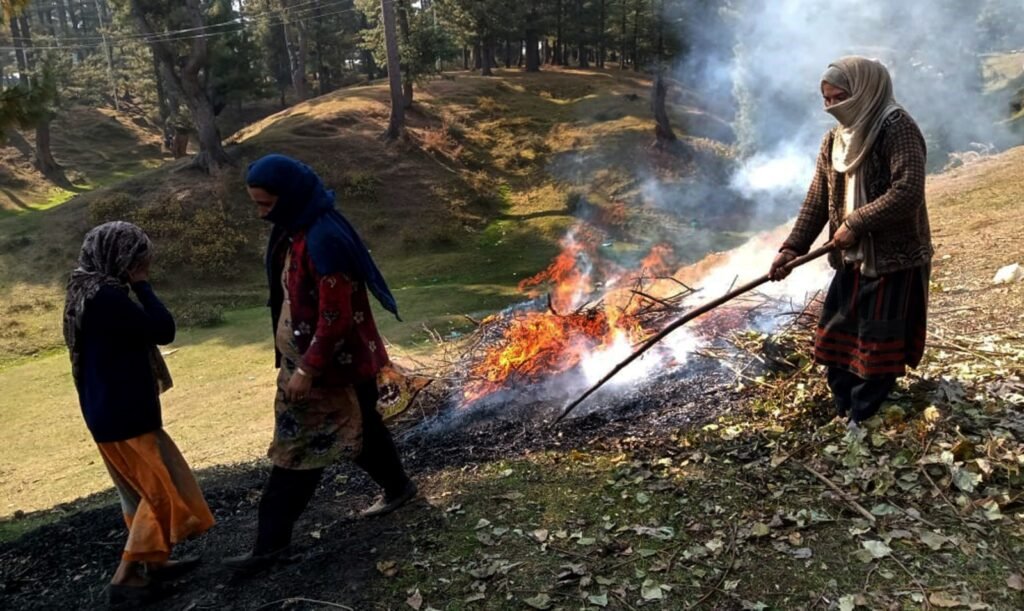
Unfortunately, the practice of burning leaves and waste in open spaces continues in several localities.
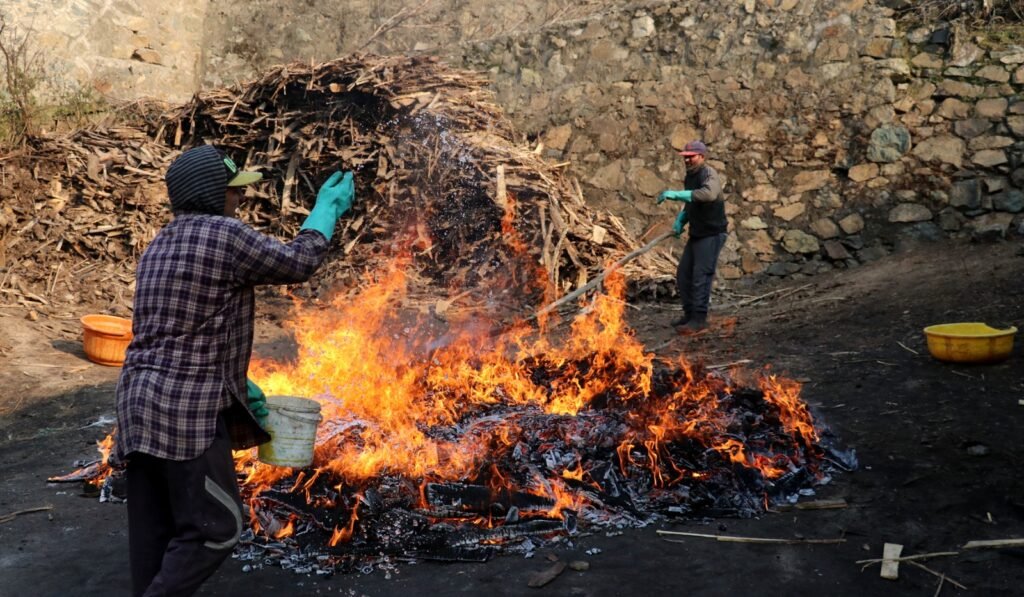
This releases smoke and fine particles directly into the atmosphere. In winter, when dispersion is already limited, even localised burning can worsen the pollution burden.
Open leaf burning must be discouraged and replaced with scientific composting and waste management.
5. Construction dust and industrial emissions
Unregulated construction, uncovered building materials, road dust, poorly managed demolition waste and emissions from industrial units add to the pollution load.
Industrial areas such as Khrew and Khonmoh also require continuous monitoring and strict compliance with emission standards.

Environmental protection must not be treated as an obstacle to development. Rather, it should be an essential component of responsible development.
The Health Cost of Breathing Polluted Air
Air pollution is not merely an environmental issue; it is a public health emergency in the making.
PM2.5 particles are particularly dangerous because they are extremely small and can penetrate deep into the lungs. Some may enter the bloodstream, contributing to inflammation and increasing the risk of cardiovascular and respiratory diseases.
Children, elderly citizens, pregnant women, outdoor workers and people with asthma, chronic obstructive pulmonary disease (COPD) or heart conditions are particularly vulnerable.
Prolonged exposure can increase the risk of respiratory illness, cardiovascular complications and premature mortality.
In Kashmir, where winter already brings a seasonal increase in respiratory infections and breathing difficulties, worsening air quality can place additional pressure on families and healthcare institutions.
We must stop treating pollution as a problem that can be ignored until the arrival of rain or snowfall.
What Must Be Done? A Practical Roadmap for Cleaner Winter Air
The solution requires coordinated action by the government, local authorities, scientific institutions, communities and citizens.
1. Establish a Winter Clean Air Action Plan
The administration should introduce a dedicated winter air pollution response plan for Srinagar and other vulnerable towns.
The plan must include pollution alerts, source-specific interventions, traffic management, enforcement against open burning and emergency measures during severe pollution episodes.

Air quality data should guide action rather than remain limited to dashboards and reports.
2. Expand real-time air quality monitoring
The monitoring network must be expanded across Srinagar and other urban and semi-urban areas of Kashmir. Monitoring should cover residential neighbourhoods, schools, hospitals, traffic corridors, industrial areas and ecologically sensitive locations.
Data from low-cost sensors should be calibrated and validated against reference-grade instruments wherever possible. A publicly accessible air quality dashboard can help citizens understand local pollution levels and make informed decisions.
3. Stop open burning of leaves and waste
Municipal authorities must ensure door-to-door collection of horticultural waste and establish decentralised composting facilities. Leaf waste can be converted into compost and organic manure rather than being burnt.
Strict enforcement against open burning should be accompanied by practical alternatives for residents, gardeners and horticultural workers.
4. Promote clean and affordable heating
A transition towards cleaner heating systems is essential. The government should promote energy-efficient buildings, improved insulation, affordable electricity-based heating, cleaner fuel options and appropriate renewable energy solutions. A clean heating policy must consider the economic realities of households, particularly those living in rural and economically weaker areas. People cannot be expected to abandon traditional heating practices without access to affordable alternatives.
5. Improve public transport and reduce vehicle emissions
Srinagar requires a stronger public transport system, better traffic management and improved pedestrian infrastructure. Regular emission testing, vehicle maintenance, enforcement against visibly polluting vehicles and the promotion of electric mobility should be prioritised. During severe pollution episodes, authorities should consider targeted restrictions on high-emission vehicles and unnecessary traffic movement.
6. Enforce construction and industrial pollution standards
Construction sites should be required to cover materials, control dust, manage debris and follow environmental safeguards. Industrial units must operate within prescribed emission limits, with regular inspections and transparent compliance reporting. Development projects should undergo meaningful environmental assessment, especially in ecologically fragile areas.
7. Protect green spaces and urban forests
Trees and green spaces are essential for a healthy urban environment. However, plantation alone cannot solve the problem of air pollution. Srinagar needs a comprehensive urban green strategy that protects mature trees, restores degraded green spaces, develops suitable urban forests and prevents unnecessary tree cutting. The focus must be on protecting existing natural assets while increasing green cover through scientifically planned interventions.

8. Make schools, hospitals and communities part of the solution
Environmental education must move beyond textbooks and reach the grassroots. Schools, colleges, hospitals, resident welfare groups, NGOs and community organisations can help create awareness about air pollution, its health impacts and preventive measures. Every neighbourhood should become a partner in the mission for cleaner air.
Real-Time Monitoring Must Lead to Real-Time Action
The readings recorded on 1 November 2026 are a reminder that environmental monitoring is only the first step. The real purpose of monitoring is to identify pollution sources, understand trends and trigger timely action. We need a system in which rising pollution levels lead to immediate administrative response, public communication and targeted interventions. A sensor that records pollution but fails to influence policy or public behaviour cannot deliver the environmental protection that our people deserve.

The BreatheOSS monitoring platform and similar initiatives can contribute meaningfully by increasing public awareness and providing localised information. However, long-term solutions must be built on reliable scientific data, regulatory enforcement and community participation.
Kashmir Cannot Afford to Lose Its Clean Air
Kashmir’s environmental identity is inseparable from its mountains, forests, wetlands, lakes and fresh air. As we speak about tourism, economic growth, urbanisation and development, we must also ask a fundamental question: What is the value of development if the air we breathe becomes unsafe? The responsibility for cleaner air does not rest with the government alone. It belongs to every citizen, every institution, every business and every community. We must stop burning leaves, reduce unnecessary vehicle use, adopt cleaner heating practices, protect our forests and demand stronger environmental governance.
The winter pollution crisis is not inevitable. It can be controlled through scientific planning, responsible policy and collective action. Kashmir does not merely need cleaner air for the coming winter. It needs a long-term commitment to protect the health of its people and the ecological integrity of the Himalayas.
Let us make clean air a public priority—not just an environmental slogan. Because the right to breathe clean air is not a privilege. It is a fundamental necessity of life.